

The Hamilton Project held a forum, “PhDs, Policies, and Patents: Innovation and America’s Future,” on June 28, 2011. The discussion explored the evolving role of innovation in driving broad-based economic growth in the United States and the policy environment necessary to foster new ideas in science, technology, and business. From that conference The Hamilton Project pulled from the statements of each of our panelists to identify a dozen facts about innovation.
During the past century, innovation in mechanics, computing technology, medicine, and business practices has driven economic growth, raised wages, and helped Americans lead longer and healthier lives. The development of assembly line production, for example, and its application to the mass production of automobiles reduced the time to produce the Model T Ford by 68 percent over six years and reduced its cost by 62 percent, allowing middle-class families to afford what had once been a luxury (Williams, Haslam, and William 1992). The rapid pace of innovation and increases in productivity continued for most of the century, expanding the efficiency of American workers and providing more valuable goods and services at lower prices.
Since the 1970s, however, the pace of innovation has slowed, leading to lower overall wage growth for American workers. Moreover, those gains that have been made have not been shared equally across society. Although average wages have risen, buoyed by strong gains at the top of the distribution, the wages of many Americans have stagnated or fallen after adjusting for the cost of living over the past forty years. Reinvigorating the momentum of innovation that benefits all Americans is imperative to create broad-based economic growth and higher living standards.
To take on this challenge, The Hamilton Project held a forum, “PhDs, Policies, and Patents: Innovation and America’s Future,” on June 28, 2011. The discussion explored the evolving role of innovation in driving broad-based economic growth in the United States and the policy environment necessary to foster new ideas in science, technology, and business. From that conference The Hamilton Project pulled from the statements of each of our panelists to identify a dozen facts about innovation.
Read the full introduction
These dozen facts encapsulate three themes: First, innovation has historically improved America’s overall standard of living through higher wages, lower prices, and health advancements. Second, the pace of innovation has slowed more recently and the gains from innovation have not benefitted all Americans. Third, in today’s increasingly competitive global economy, current U.S. policies are not doing enough to promote innovation. Without purposeful policies and necessary investments to spur innovation, the United States may not experience the same sort of economic and technological advances in the current century that we enjoyed in the past.
The Benefits of Innovation
Innovation is the process of discovering new ideas and realizing those ideas at large scale, changing the ways we live and work. Innovation has transformed the American economy through the development of automobiles and highways, airplanes, telecommunications, and the internet, all of which have made it progressively easier for businesses to market their products globally and connect their best workers to one another. Innovations like these drive economic growth by helping businesses produce more with less—progress that is measured as rising productivity. As businesses and workers become more productive, the prices of goods and services fall and workers’ wages rise, improving our standard of living.
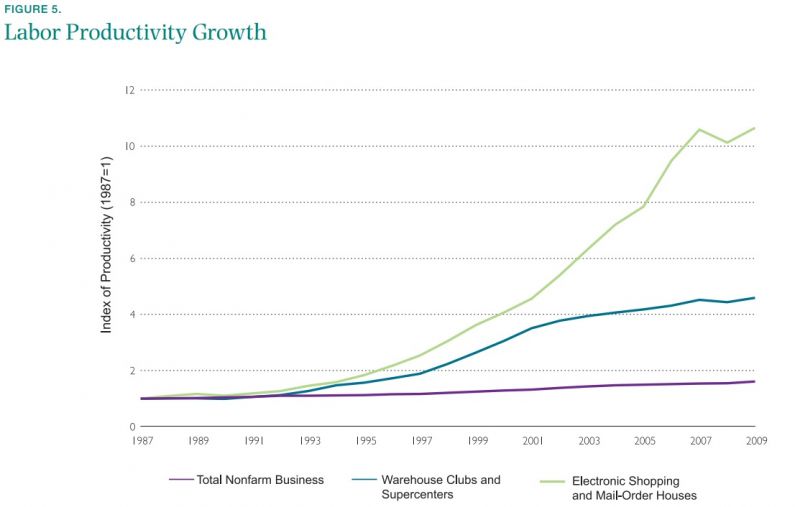
The first five facts in this policy memo help illustrate the benefits of innovation, starting with a look at the central role innovation has played in driving economic growth and raising average wages (Fact 1). The next four facts illustrate striking advances in medicine, business, and technology that have broadly benefited the American people. Public health advances and the development of vaccines and antibiotics have contributed to increases in life expectancy (Fact 2). Computing and telecommunications technology have made personal computers and mobile phones available to almost the entire population (Fact 3). More mundane organizational changes and behind-the-scenes improvements in management and procurement have allowed businesses to cut waste and deliver cheaper products to consumers (Fact 4). Innovations in the home, such as sophisticated household appliances that make housework faster and easier, have allowed Americans to enjoy more leisure time (Fact 5).
The Slowing Pace of Innovation
In the 1970s, the pace of innovation slowed and average wage growth followed suit. Fact 6 demonstrates how economic growth from innovation is measured and illustrates the lost income from the slowdown in innovation.
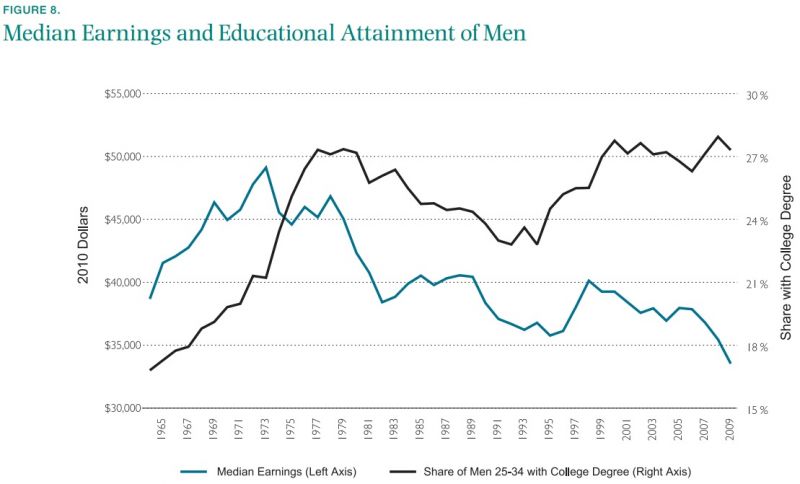
Beyond slowing average wage and productivity growth, the gains have not benefited all workers equally. Fact 7 demonstrates that the the man in the middle of the earnings distribution or the median man now earns about 28 percent less than his counterpart forty years ago. (Mean or average earnings increased, even in the face of the decline in wages at the median, due to the sharp increases in earnings at the top of the income distribution.) Education, in particular, is a key factor behind stagnant wages and declining earnings. A college graduate now earns about double what an individual with only a high-school diploma earns, but rates of educational attainment among men have been flat for thirty years. In contrast, women have seen earnings increase, in part because of rising educational attainment.
What Is the Future of U.S. Innovation?
Government policies can help reignite the engine of productivity growth by creating a fertile environment for innovation. One component of such an environment is a regulatory framework that does not unnecessarily burden businesses and creative entrepreneurs (Fact 8).
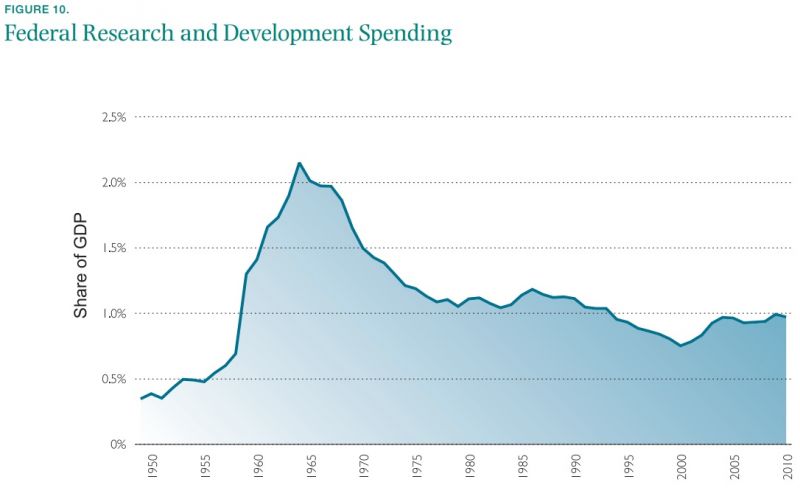
At the same time that productivity growth has slowed, the United States’ investments in many productivity-enhancing areas are lagging. Federal research and development (R&D) as a percent of GDP has declined from an average of 1.2 percent in the 1970s to 0.7 percent in the 2000s (Fact 9). Government funding for R&D is critical because the private sector may lack incentives to engage in the basic research that plays a critical role in productivity growth.
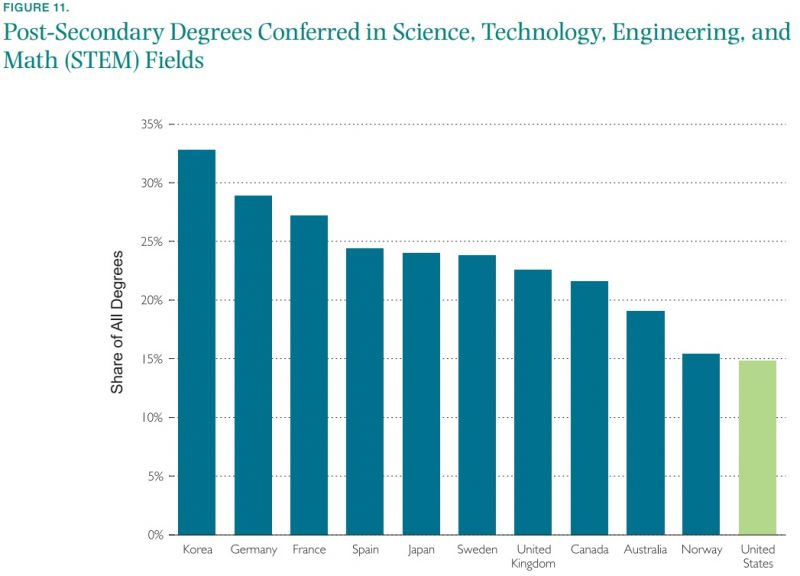
Nor is the United States producing enough talent in science, technology, engineering, and math (STEM) fields that are critical to innovation. Among OECD countries, the United States has one of the lowest shares of degrees awarded in STEM fields (Fact 10). Women are starting STEM majors in undergraduate studies, but are less likely to continue into graduate study than are their male counterparts (Fact 11). Recently, high-skill immigrants have pursued careers in these fields at high rates at American colleges and universities. More than 40 percent of STEM PhDs were awarded to foreign-born students (Fact 12). Without appropriate immigration policies, more and more highly educated foreign students may leave the United States after studying here—taking their skills with them.
Achieving robust and broad-based economic growth requires effective government policies, and these policies often involve making difficult political choices that involve reprioritizing expenditures toward policies that promote future prosperity. The alternative is slowing productivity gains and uneven growth that leaves many families behind and undermines the core of the American Dream that each generation will have an opportunity to do better than the previous one. Recognizing the importance of such policies, The Hamilton Project has offered proposals to fund more fellowships for students pursing degrees in science and engineering, expand the use of prizes for scientific discoveries, and streamline the process of obtaining patents. Drawing from this previous work and the 2011 forum, The Hamilton Project will continue to seek out policy ideas to increase innovation, economic growth, and broad participation in that growth.
Chapter 1: The Benefits of Innovation
Fact 1: Innovation drives economic growth and raises wages.
America has long had a culture and an economic system that has spurred innovation and scientific advance that in turn created vast new industries, enormous numbers of jobs, and a powerful competitive position in the global economy
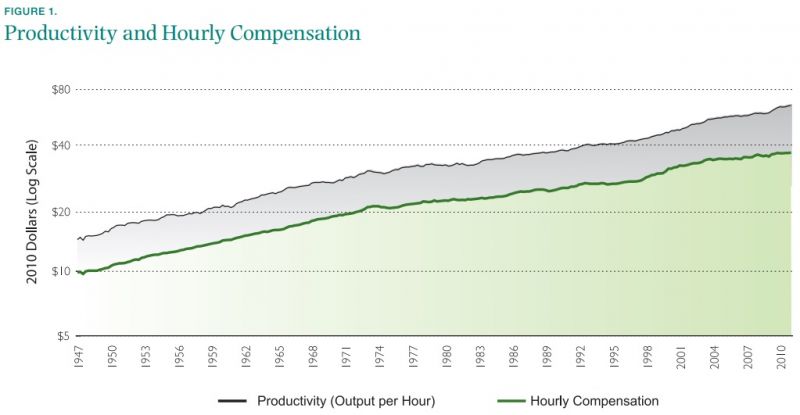
When workers can produce more, they earn more. In the latter half of the past century, labor productivity and hourly compensation (wages and benefits) increased at a rate of about 2 percent per year. Real hourly compensation increased from an average $9.88 per hour in 1947 to $35.44 per hour today. These improvements in compensation and the rising living standards they afford reflect innovations that have made businesses and people more productive.
Although average compensation increases follow productivity growth, the wage gains need not be equal across the population. As is discussed in more detail in Fact 7, earlier gains from innovation benefitted Americans broadly. However more recently, wage increases have been concentrated at the top and many Americans have experienced wage declines.
Fact 2: Innovation improves U.S. life expectancy.
Longevity has improved by about one year every six years in this country . . . if you add up what that’s contributed to the economy since 1970, that’s estimated to be worth about $95 trillion.
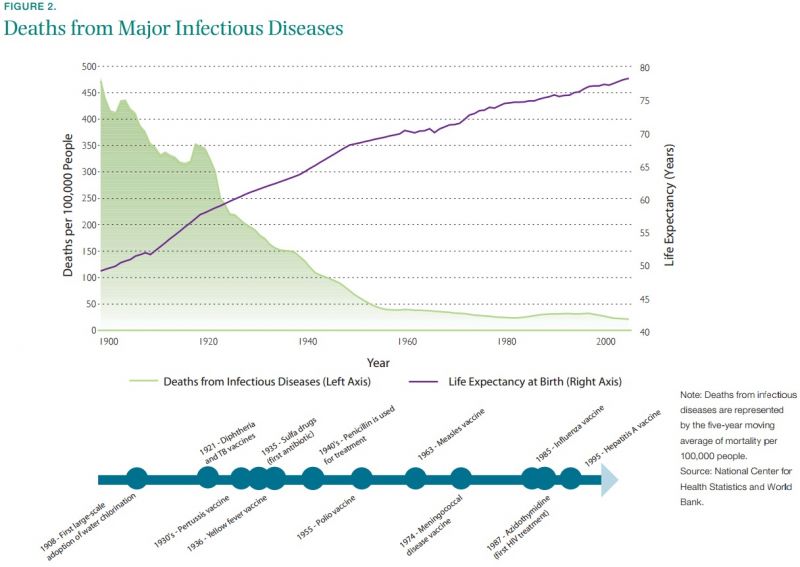
In 1920, average life expectancy in the United States was only fifty-eight years. By 1960 it had jumped to seventy years and today it is seventy-nine years. These rapid increases in life expectancy were brought about by medical innovations and improvements in public health practices. One example of how innovation improves longevity is the steep drop in mortality from infectious and bacterial diseases.
Technological improvements, such as filtration and chlorination of water in cities significantly contributed to mortality reductions in the earlier half the twentieth century. According to some estimates, cleaner water accounted for nearly half of the mortality reduction in American cities from 1900 to 1936 and produced health benefits for Americans twenty-three times higher than the costs of the investments (Cutler and Miller 2005). Reductions in the incidence of mortality from infectious diseases were also brought about by the development and dissemination of vaccines and antibiotics, such as penicillin (CDC 1999).
Fact 3: Innovation makes technology affordable.
Most people don’t think about disk drives but they store, search, and retrieve almost limitless amounts of information today and now, with cloud computing, can be accessed wirelessly. I used to say that you have now the Library of Congress on your computer. Now you have the ability to access almost all the world’s information in your pocket.
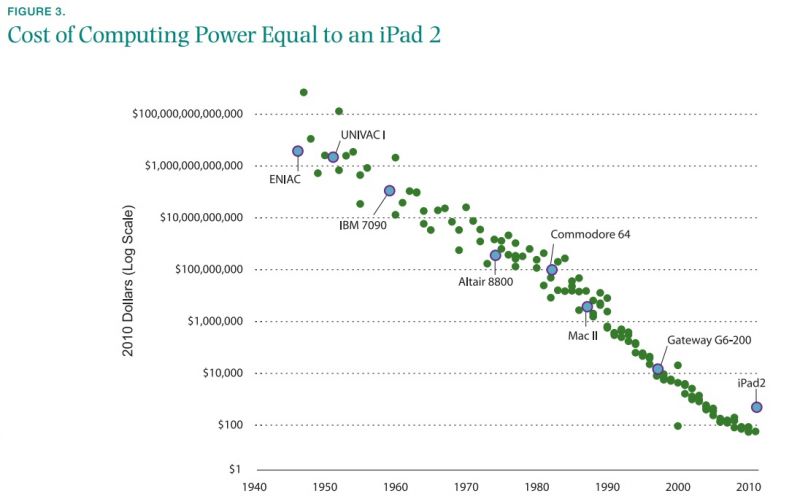
Consumer technologies like personal computers and mobile devices make all of our lives easier, allowing us to quickly connect with people across the world and retrieve information regardless of our location. The price of these technologies has decreased rapidly, even more so than the sticker price would indicate, because new computers are so much more powerful than older iterations. The latest computer may be more expensive than the previous model but relative to what the computer has to offer, the cost is lower. If the typical worker in 1982 wanted to purchase something with computing power of an iPad2, it would have cost more than the 360 years worth of wages.
Farmers [in developing countries] are using cell phones to text message their water sprinklers miles down the road to turn on and off. And they’re becoming a lot more productive with pricing transparency, taking advantage of inefficiencies and arbitrage in the market. . . . They’re harnessing the power of technology to improve their lives and work.
In both industrialized nations and emerging markets, technology can revolutionize business and improve markets. To give one salient example, between 1998 and 2002, mobile phones were introduced to the coast of southern India. Before the introduction of mobile phones, fishermen would take their catch to their local market, where sometimes there were few customers or too much competition, and fish would go to waste. On average, about 7 percent of the fishermen reported waste, and on some days almost 24 percent of fishermen lost money on wasted fish. When cell phones were introduced, fishermen could find out what the price was in different markets, and take their fish to markets with higher demand. The result was the complete elimination of wasted fish (Jensen 2007).
Fact 5: New household technologies allow more time for family and leisure.
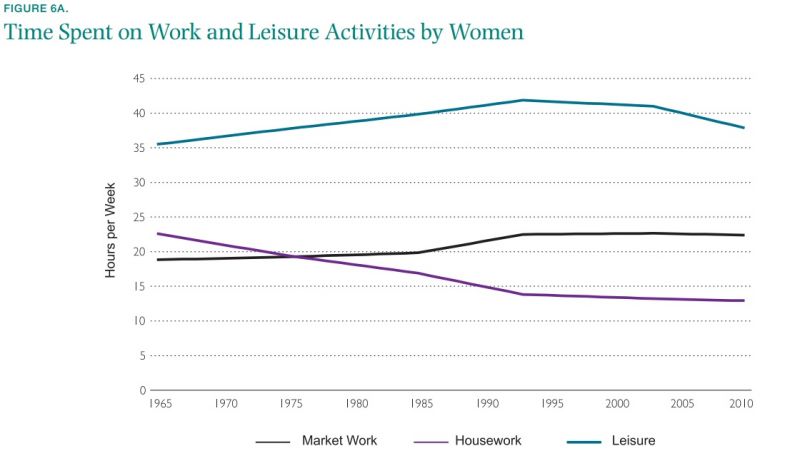
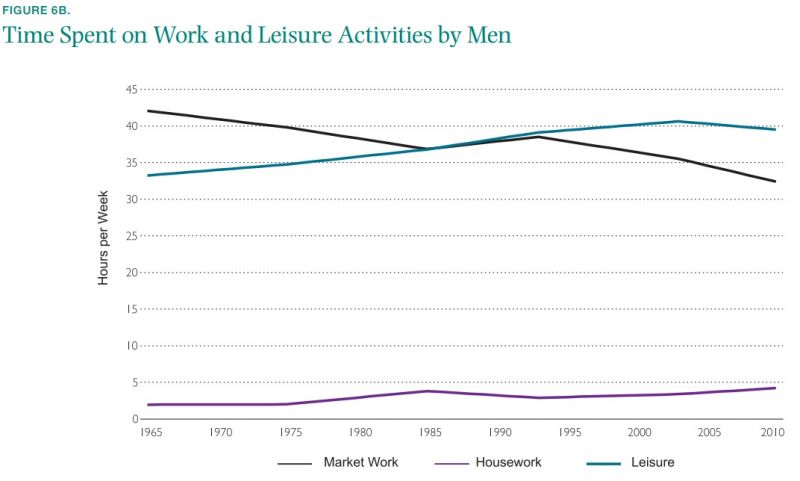
In the 1960s and 1970s household appliances such as microwaves, dishwashers, and clothes dryers were developed and became commonplace. The clothes dryer, first marketed in the early 1950s, was in 50 percent of all households by the early 1970s (Bowden and Offer 1994). The development of household appliances made it easier to complete household chores such as preparing meals and doing laundry. As this sort of work was predominantly done by women, the number of hours spent on household work by women declined substantially. Compared to 1965, women spent 9.7 fewer hours per week doing housework, amounting to 12.9 hours per week in 2010. Men’s time spent doing housework actually increased slightly—by 2.3 hours per week—totaling 4.2 hours per week.
With less time going to household work, more time is spent on leisure. Leisure increases also come about because of rising wages; as basic needs are met, individuals are more likely to choose leisure over work.
Incorporated into the definition of leisure is time spent caring for children. The time devoted to childcare has risen for both men and women. A narrower definition of leisure that excludes childcare has also increased for both men and women.
Chapter 2: The Slowing Pace of Innovation
Fact 6: The pace of American innovation has slowed during the past four decades.
If we look at measures of what economists call total factor productivity, growth has mostly been low since 1973. That is, we are innovating at a slower pace. We’re relying more on people to work longer hours to get more output.
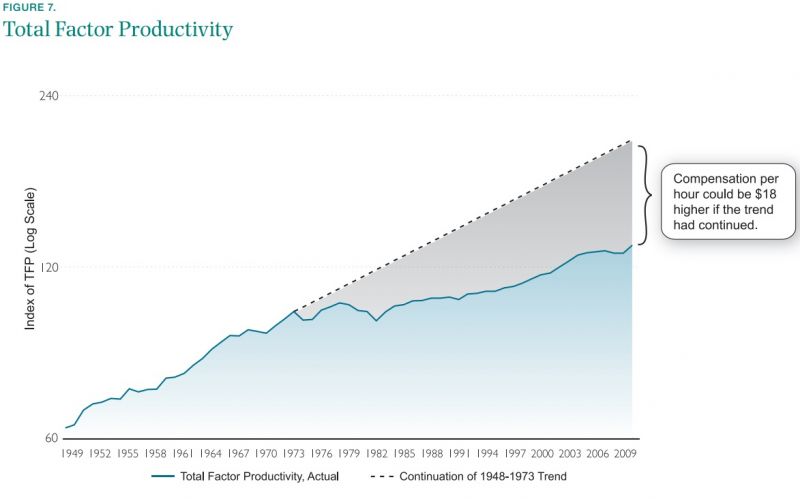
Innovation contributes to economic growth as businesses use new technologies and ideas to produce more with fewer resources. The economic growth not accounted for by known factors such as increases in the number of machines, labor, or a more educated workforce is called total factor productivity (TFP) growth. TFP thus measures any advancement that has been made in how to use existing resources to increase overall output and incomes. Those advancements can be technological, as is the case with the internet, which helps people accomplish tasks faster, medical, because healthier people are better workers, or organizational changes that help businesses produce more such as the assembly line.
Since 1973 the pace of innovation, as measured by TFP growth, has slowed. Prior to 1973, TFP increased at an annual rate of 1.9 percent, but since then this growth rate has fallen to 0.7 percent. If TFP had continued growing at the pre-1973 trend and that productivity gain were reflected in workers’ compensation, compensation could be 51 percent higher, or about $18 per hour more than today’s average of $35.44 per hour. This calculation highlights that small changes in innovation and annual TFP growth lead to large differences in long-run standards of living.
Fact 7: Innovation has failed to increase wages for a substantial number of Americans.
There’s a clear recognition that innovation can be compromised if rules are redundant, inconsistent, or overlapping. And if you want to free up the private sector to innovate, we need to get that problem under control.
Average earnings growth tracks the growth of labor productivity, as Fact 1 illustrates. One implication of slowing productivity growth is that average earnings growth has slowed too. But for many Americans, the story is not just one of slowing gains but of outright declines in earnings, because increases in average wage growth have not been widely shared. Earnings for men in the middle of the income distribution have actually declined by around 28 percent since 1969 because of stagnating wages for those men that do work and because of declining employment rates.
Stagnating wages and declining employment opportunities for men are in part due to a failure to increase educational attainment. The market has signaled that education is extremely valuable: college graduates have roughly double the earnings of high school graduates. Indeed, even after accounting for the full costs of college attendance, the internal rate of return to completing a bachelor’s degree is 15.2 percent and exceeds other standard investments. The share of women receiving bachelor’s degrees has been on the rise but the rate of bachelor degree receipt among men has stagnated. In the late 1970s, about 27 percent of men aged twenty-five to thirty-four had graduated from college; since then, the share fell through the 1980s and has only recently approached the level it was thirty years ago.
Women have seen greater earnings increases than men because of rising rates of educational attainment and labor force participation, the entry of female workers to higherpaying professions, and longer work hours. In the past decade, however, wages of women have begun to stagnate as well.
Chapter 3: What is the future of U.S. Innovation?
Fact 8: Significant barriers to innovation exist in the government and the private sector.
There’s a clear recognition that innovation can be compromised if rules are redundant, inconsistent, or overlapping. And if you want to free up the private sector to innovate, we need to get that problem under control.
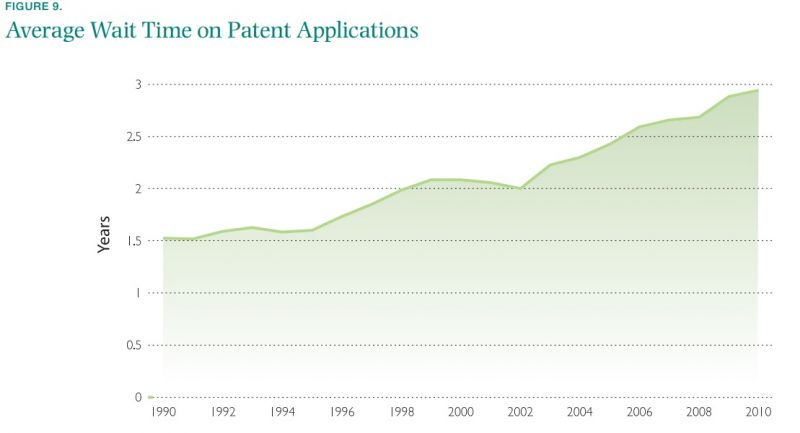
Effective government is important for fostering innovation. One role of the government is the approval of patents, which encourages innovation by allowing individuals to profit from their ideas. The time for approval of patents has nearly doubled since 1990, rising from 18.3 months to 35.3 months in 2010.
Governments also need to establish a regulatory environment that reduces uncertainty for innovators and that reduces barriers to innovation. Regulations exist to protect the health and welfare of us all, but those benefits must be weighed against the costs to consumers and businesses of complying with those rules.
Work changes not at the pace of the new enabling technologies that enter it but at the pace that organizations change to take them up. And that’s slower. It’s slower to change bureaucracies around.
Barriers to innovation also exist within the private sector. Sometimes great ideas can be stymied by organizations that are resistant to change, and it is often the case that technologies are developed for which there is no existing infrastructure. Many businesses have not yet figured out how tools such as the iPad or social networking programs like Facebook can be used to make workers more productive; nor have many figured out how to use many emerging health technologies so that benefits exceed costs.
Fact 9: Federal support for research and development has declined in recent years.
I’m sure we are missing out on opportunities that could be supported if we were in a more favorable environment– because it’s very hard to assess when you look at a proposal whether, in fact, this is going to be a successful new innovation. Sometimes it’s the wacky science that you most don’t want to miss supporting. Yet wacky science at a time where you’re only funding one out of six grants may be difficult for our peer review process to identify and say, yeah, we’re going to do that–even though it means not doing some very solid, established science that’s in the same pool.
Government investment in research and development (R&D) as a percent of GDP has declined from a high of 2.2 percent in 1964 to 1 percent today. Support of federal R&D spending is critical to U.S. innovation because government can sponsor the kind of “basic” research projects that seek wide-ranging scientific understanding that can affect entire industries, rather than individual firms. In contrast, private sector firms tend to focus their R&D on “applied” projects, where they can capture the entire payoff. Their role is not to undertake broad R&D for the general benefit of our nation. For example, in the 1960s, the Defense Advanced Research Projects Agency sponsored efforts to develop the structure and technologies that now form the foundation of the modern internet. A team of computer scientists at the agency created revolutionary new protocols to allow computers to communicate across the country. Other products resulting from federal investments in basic research include barcodes, fiber optics, magnetic resonance imaging (MRI) machines, and GPS technology. The U.S. government has historically funded about half of all basic research, whether done within the government or at universities. Less than 5 percent of R&D performed by industries is in basic research.
Fact 10: Relatively few U.S. college students study fields critical to innovation.
Why don’t we have more advanced manufacturing in the United States? In PCAST’s report on advanced manufacturing for the President, we talked to a number of companies. The most consistent reason was “We can’t find the types of workers we need. . . . Getting enough factory floor engineers, not necessarily with fancy engineering degrees, but with the ability to be quantitative and increase a factory’s efficiency . . . was again and again cited as a frustration with doing business in the United States.
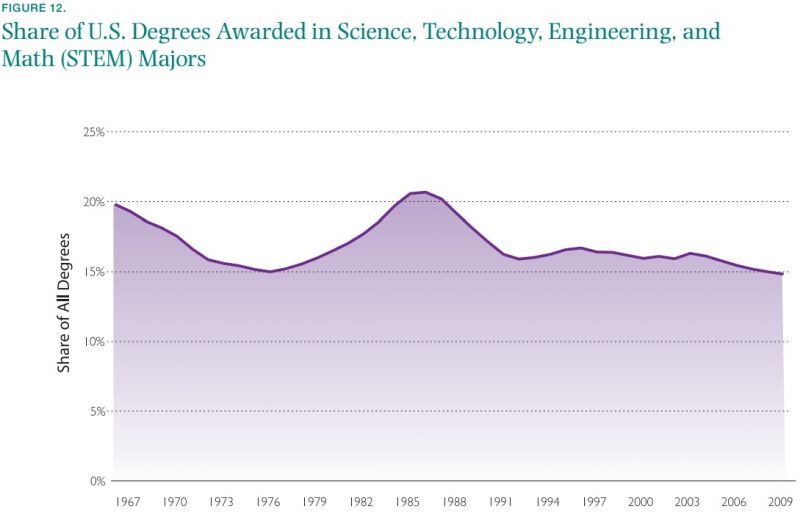
The United States lags behind other countries in training students in STEM fields that help advance scientific and technological progress. The share of post-secondary degrees in STEM fields is twice as high in South Korea as it is in the United States.
The share of U.S. degrees in science, technology, engineering, and math (STEM) fields rose in the 1980s as computer science became popular, but this was a short-lived trend. In the 1990s, the share of bachelor’s degrees in STEM fields leveled off and the share of advanced degrees declined. The total number of doctorates awarded in the physical sciences and science technologies actually remained constant from 1970 to 2008 despite a rising number of doctorates awarded.
Fact 11: American women are less likely to continue in STEM fields than American men.
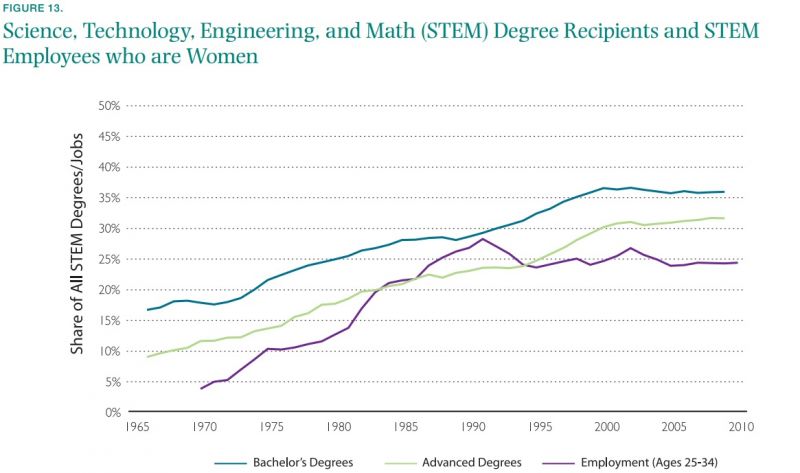
The share of science, technology, engineering, and math (STEM) degrees awarded to women was on the rise at both the undergraduate and graduate level through 2000 but then leveled off. Moreover, the two trends never converge, indicating that women’s progress in STEM fields at undergraduate levels has not been fully realized at more advanced levels. In contrast, the share of men studying STEM fields is relatively similar for both undergraduate and graduate students.
Recent employment trends show a similar pattern. Women’s representation in STEM employment increased up until the 1990s along with their share of STEM graduates, but women’s percent of STEM employment leveled off more quickly. Currently, women are still underrepresented in STEM employment relative to their representation in either bachelor’s or advanced degree obtainment. Although there is a lag between undergraduate and graduate degree receipt, the data still suggest that there is a leaky pipeline moving women from undergraduate study in STEM to more advanced study and employment in those fields.
Fact 12: U.S. policy makes it difficult for international students to stay and work.
We’ve had a great opportunity in the past to recruit bright minds from all over the world. Many of them have stayed and become central to our own national success. But they are increasingly not staying. The opportunities to go back home in places like China and India are getting very strong, and our visa policies have not particularly been friendly to many of those individuals.
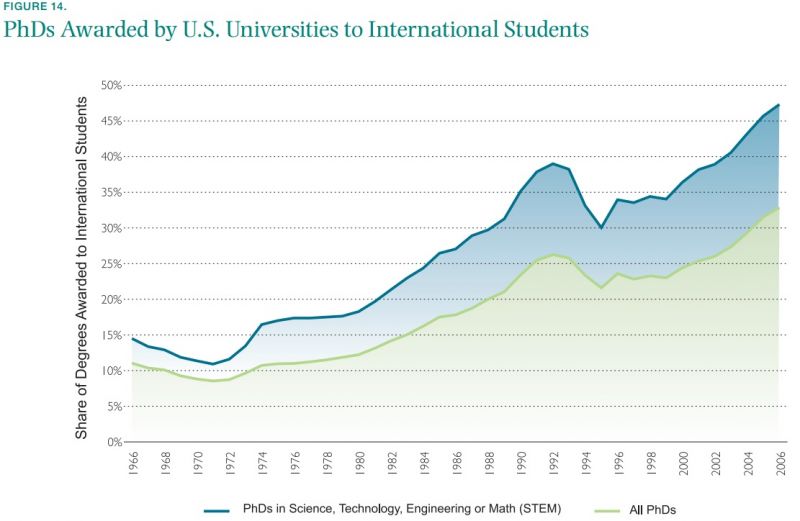
American universities are attracting more international students, and these students account for an increasingly large share of advanced degrees. In 2006, more than 30 percent of all PhDs in the United States were awarded to noncitizens. Noncitizens made up an even larger share of PhDs in science, technology, and math (STEM) fields—about 47 percent.
Moreover both the share of all PhDs going to noncitizens and the share of STEM PhDs going to noncitizens have been increasing rapidly in recent years.
Universities clearly recognize the talents of international students, but it is less clear whether our immigration policy makes it easy to integrate these students into the workforce. The Hamilton Project’s previous release, “Ten Economic Facts about Immigration,” further explores the benefits of immigration for our economy.