


The Jobs Gap Has Closed
The Great Recession caused labor market devastation on a scale not seen for many decades. Millions of jobs were lost in the United States during 2008 and 2009, leaving the labor market with a hard road to recovery. Indeed, that recovery has required many years of job growth, and it was only in April 2014 that total employment reached its pre-recession level.
However, this milestone did not mark a return to pre-recession labor market conditions. Because the U.S. population is growing, simply reaching the previous number of jobs is not sufficient to return to pre-recession employment rates. At the same time, more baby boomers have entered retirement, somewhat offsetting the effects of population growth and reducing the number of jobs needed for a full economic recovery.
In order to accurately track the progress of the labor market recovery, The Hamilton Project developed a measure of labor market health—the “jobs gap”—that reflects changes in both the level and the demographic composition of the U.S. population (more details regarding the jobs gap methodology are provided in appendix A). Beginning in May of 2010, The Hamilton Project has calculated the number of jobs needed to return to the national employment rate prior to the Great Recession, accounting for population growth and aging.
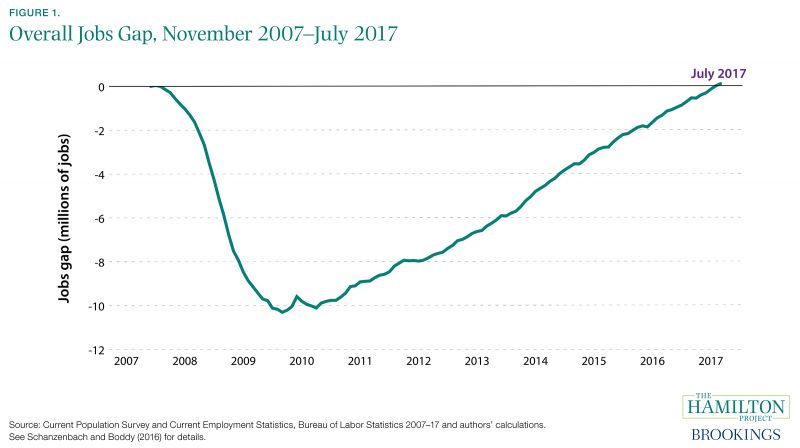
With today’s employment report, we can report that the national jobs gap relative to November 2007 has closed (see figure 1). This indicates that, by our calculations, nearly a full decade after the start of the recession, employment has returned to its demographically adjusted pre-recession level. This does not mean that all harm to the labor market resulting from the Great Recession has dissipated, nor that the economy is at full employment. It does mean, though, that the economy has added enough jobs to make up for the losses during the Great Recession.
Because the population was growing while the labor market was shedding jobs, the trough of the jobs gap (more than 10 million jobs needed to recover to pre-recession employment rates) exceeded the actual decline in number of jobs (about 8.5 million). The average rate of recovery in the jobs gap after the trough of the Great Recession was 116 thousand jobs per month, and it took 89 months to close the gap.
To be sure, the closing of the jobs gap does not mean that the labor market scars of the Great Recession are entirely healed. Indeed, while some economic markers indicate a tight labor market—a low unemployment rate and relatively abundant job openings—others, like the depressed 25- to 54-year-old employment rate, an elevated share of people working part-time for economic reasons, and restrained wage growth, are consistent with a weaker labor market. The decline in the employment-to-population ratio for 25 to 54 year olds has been offset to some degree by rising employment rates for those 55 and older, helping to close the jobs gap.1 Since November 2007, the overall labor force participation rate has fallen from 66.0 percent to 62.9 percent. However, much of this drop was due to demographic change, and a slight reduction in the unemployment rate over that period helped to mitigate the impact on employment. Appendix A provides additional detail regarding the economic forces underlying movement in the jobs gap.
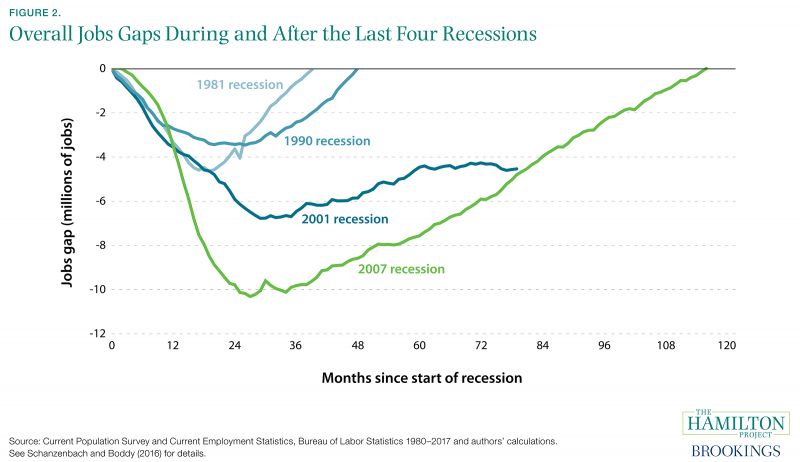
In figure 2, we apply the jobs gap methodology to three other recent recessions: 2001, 1990, and 1981. Compared to these recessions, the jobs gap during the Great Recession was much larger and took years longer to close. The recessions of 1981 and 1990 involved smaller and briefer jobs gaps, with recovery to the demographically adjusted, pre-recession employment rate after 40 and 48 months, respectively. The 2001 recession saw a more gradual decline in jobs, and a slower recovery; the jobs gap from the 2001 recession did not close before the Great Recession started. The fact that the labor market was not necessarily at full strength at the start of the Great Recession is one reason the closing of the jobs gap does not necessarily signal an end to “slack” in the labor market: the under-used labor that could be profitably employed.
An Uneven Recovery
The labor market recoveries depicted in figures 1 and 2 reflect the overall experience of the entire United States. However, not all regions of the country or demographic groups experienced the same recovery—while some groups have reached and substantially exceeded their pre-recession employment rates, others have lagged behind.2 Because the payroll employment data (from the Current Employment Statistics survey) do not include information on demographic characteristics, we use individual-level Current Population Survey (CPS) data in these calculations. These data are less current than the payroll data—we use individual-level data through May 2017—and the growth in employment measured in the CPS is somewhat lower. Given these differences and the distinct features of the CPS data, we will now implement the jobs gap concept as an “employment rate gap,” defined as the difference between the demographically adjusted 2007 employment-to-population ratio and the actual employment-to-population ratio at a given point in time.
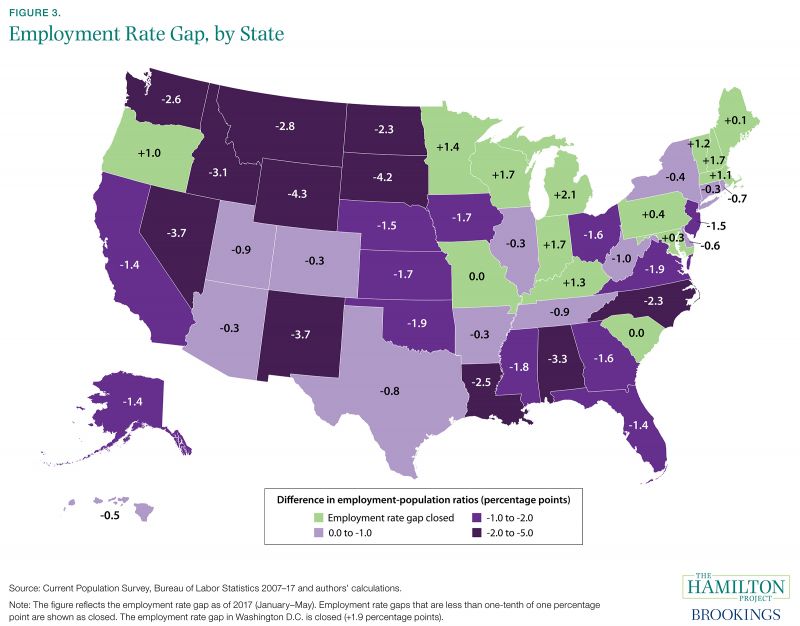
The long-run impact of the Great Recession was particularly uneven across regions of the country, leaving some states with larger 2017 employment rate gaps than others. Figure 3 shows the 2017 employment rate gap by state, giving a sense of which places have prospered relative to their 2007 baseline and which have not. To account for varying population levels and changes across states, we calculate the gap as the difference between the actual 2017 state employment rate and the demographically adjusted state employment rate. States shown in light green have reached or exceeded the demographically adjusted employment rates that prevailed before the Great Recession, while purple states continue to face employment rate gaps of varying sizes. States in the Northeast and Midwest have seen particularly strong job growth, adjusting for demographic change; for example, Massachusetts has closed its gap and added 1.1 percentage points. Some of the largest remaining gaps are observed in Western states, where Wyoming has the largest employment rate gap of -4.3 percentage points. Importantly, these differences may reflect differences in population growth and migration across the states.3
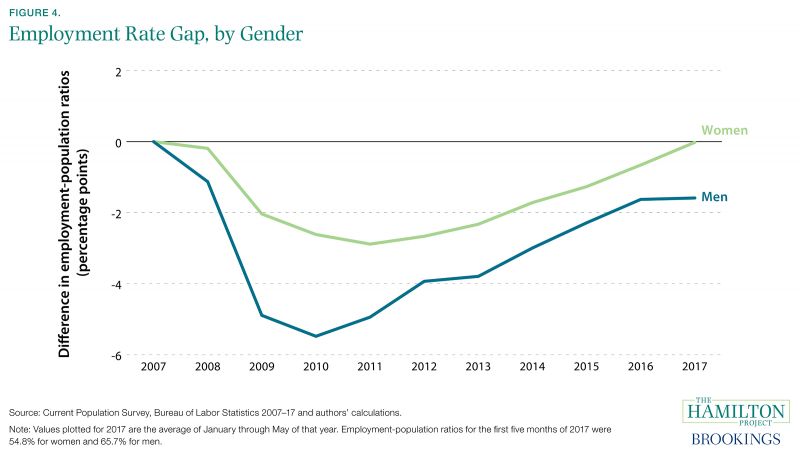
The employment rate gap recovery has been uneven in other respects: notably, women have outperformed men. Two male-dominated occupation groups—production and construction—were particularly hard hit during the Great Recession. Employment in these occupations remains low relative to other occupations, contributing to weaker employment growth for men over the last ten years. In addition, the employment rate of men aged 25 to 54 had been falling for several decades prior to the Great Recession, driven by forces that are still not entirely understood, but possibly contributing to the disparities between the employment trajectories of men and women.
Figure 4 shows the employment rate gap separately for men and women. The immediate employment loss from the recession was somewhat less severe for women, with the gap reaching a trough of -2.9 percentage points in 2011. By contrast, the employment rate gap for men reached a low point of -5.5 percentage points in 2010. Men have considerably more ground to make up than do women to regain their pre-recession employment rate: the gap for men stands at -1.6 percentage points, while it has closed entirely for women. However, it is important to note that men remain employed at a much higher rate than women, even with their relative decline over the past ten years: 65.7 percent of men and only 54.8 percent of women are employed.
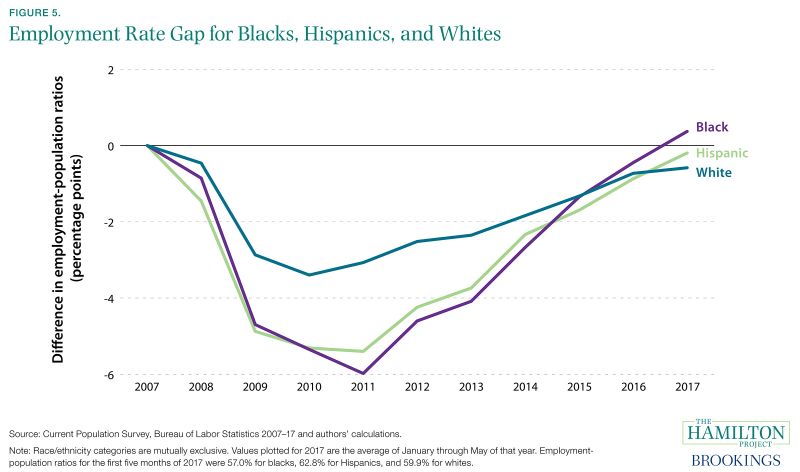
The disparate labor market experiences of racial groups over the business cycle have recently received additional deserved attention. In figure 5, we show that, while whites were less hard hit in the immediate aftermath of the Great Recession than blacks and Hispanics, their recovery has been slower; whites are now in a worse position relative to their pre-recession employment rates than are blacks and Hispanics. The employment rate gap for blacks and Hispanics fell to a trough of -6.0 and -5.4 percentage points in 2011 before narrowing to 0.4 and -0.2 in 2017, respectively. By contrast, the trough was smaller and occurred earlier for whites, at -3.4 percentage points in 2010, and whites’ employment rate gap now stands at -0.6 percentage points. It is important to remember that each group’s employment rate gap is measured relative to its pre-recession level. Blacks still face higher levels of unemployment and lower levels of employment than Hispanics or whites.
In appendix B, we explore differences by race and gender in more depth, and find that the strong recovery among Hispanics is driven by women, while Hispanic males still face a -1.9 percentage point employment rate gap. Strikingly, the current gap for Hispanic women is 3.4 percentage points smaller than that of Hispanic men (appendix figure 4).
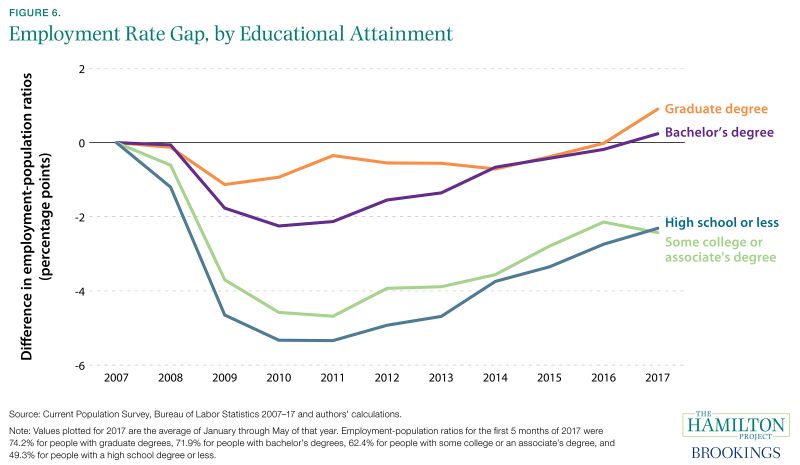
Finally, we examine the employment rate gaps for people with differing levels of education. Figure 6 shows that the employment rate gap has generally been largest for those with high school degrees or less, somewhat smaller for those with only some college or an associate’s degree, and much smaller for people with bachelor’s degrees or graduate degrees. At its trough, the employment rate gap for those with only a high school degree or less was -5.3 percentage points, as compared to -1.1 percentage points for those with graduate degrees. In fact, the employment rate gap for people with a high school degree or less is worse today than the gap was for those with a bachelor’s degree in 2010.
Conclusion
Ensuring that the gains from economic progress are broadly shared must be a primary goal of economic policy. Since its inception, The Hamilton Project has worked to this end, maintaining a special focus on employment and policies to promote both skills development and wage growth. From this perspective, the Great Recession was particularly damaging insofar as it disproportionately harmed disadvantaged individuals and families. Now that—by one important marker—American workers have returned to their pre-recession position, it is important for policy makers to have a better understanding of how the labor market evolved during the recession and recovery.
We are grateful for valuable comments from Adam Looney, Kriston McIntosh, Jay Shambaugh, and Louise Sheiner, as well as excellent research assistance from Patrick Liu, Karna Malaviya, Greg Nantz, and Rebecca Portman. In addition, we thank the many individuals associated with The Hamilton Project who have contributed to the development of the jobs gap project over the years.
Endnotes
1. Note that the Hamilton Project’s jobs gap is calculated using the Bureau of Labor Statistic’s payroll survey. This survey has shown stronger growth than the household survey, which is used to calculate employment-to-population estimates. For additional discussion of the Hamilton Project jobs gap analysis, including details of methodology and interpretation, please refer to prior publications and Appendix A.
2. Importantly, though our analysis of states and demographic groups takes the same basic approach as our national jobs gap calculation, the former differs in exclusively relying on the Current Population Survey. Because employment as measured by this dataset has recovered more slowly than payroll employment, recovery in the employment rate gap for state and demographic groups tends to be somewhat weaker. In addition, we describe the results that follow recovery in employment rates in percentage points rather than numbers of jobs. A final difference is that we present annual estimates for 2007-16. For 2017, we pool the available five months of data; seasonality does not appear to be an important factor in these calculations.
3. The case of North Dakota illustrates the employment rate gap methodology. There is a well-known economic boom in the state, which has gained 78,392 jobs since 2007. At the same time, though, migration to the state has boosted the population—particularly among younger workers with high levels of expected employment participation. The number of jobs created have not been enough to offset the change in demographic characteristics, especially since the fracking boom has subsided over the last few years.