


Millions of older adults and people with disabilities require long-term services and supports (LTSS) to assist with activities of daily living (such as eating, bathing, dressing, and mobility) and instrumental activities of daily living (such as meals and managing medication). Nearly 1.2 million individuals receive such care in nursing homes and other residential facilities, and nearly 7.3 million receive this care in home and the community. Direct care workers (DCWs), i.e., nursing assistants, home health aides, and personal care aides, represent the majority of the LTSS workforce, numbering 4.9 million workers.[1]
In both residential settings and the community, the quality of care that individuals receive is related to staffing patterns. The Centers for Medicare & Medicaid Services (CMS) has noted that nurse staffing has “the greatest impact on the quality of care nursing homes deliver,” and academic research has found that low nurse staffing levels leads to lower quality of care and higher mortality. Likewise, higher turnover among home care workers is associated with more falls, worse functional improvement, and more depressive symptoms.
Despite the importance of staffing for LTSS sectors, the labor market for these workers faces several challenges. Direct care work is challenging: Long shifts and overtime are common, injury rates are high, and pay is low, averaging $17.73 in 2025, compared to a non-farm sector average of $33.54. In many nursing homes, staffing levels are below clinical standards, and turnover is high, nearly 46 percent among nursing staff for the average facility, and with only 12 percent of facilities having turnover rates less than 30 percent. Turnover in home care agencies is similarly high. With an aging population, demand for long-term care is expected to increase, exacerbating these challenges. Recognizing the relationship between quality of care and staffing challenges, CMS is launching efforts to train and recruit nursing staff.
It is essential to understand which industries and occupations these direct care workers come from and which jobs they leave these roles for in order to design effective policies to attract and retain workers in these roles. Past work has documented that women and workers of color were less likely to leave direct care work during the COVID-19 pandemic. In this blog, we build upon earlier analyses by focusing on worker flows into and out of the direct care workforce over a longer time period. Many of the patterns observed during the pandemic are also present throughout our analysis period, pointing to longer-term trends. We leverage nationally representative longitudinal data to describe characteristics of workers who leave and those who stay in these roles, and characterize earnings trajectories for those who stay and those who move to different jobs. We report these patterns for all LTSS direct care workers, and then separately for residential care (nursing homes and residential care facilities) and home care (including home health care) workers.
We confirm high rates of turnover among LTSS direct care workers, with less than half of workers remaining as a DCW in an LTSS setting the following year. Many of those who leave LTSS DCW roles transition to non-employment, and many of those who leave the paid labor force are providing care for others while not employed. Of those who change occupations, most continue to work in health care fields. Finally, we find that older workers, those with no college education, and foreign-born workers are more likely to remain direct care workers than younger workers, those with at least some college education, and workers born in the U.S. In addition, workers who leave DCW roles to other employment receive higher wages and greater access to pensions and health insurance. Overall, these patterns suggest that most DCW turnover reflects churn within health care rather than to non-health care fields, and churn may be particularly frequent due to the low wages and benefits that DCWs generally earn. Thus, efforts to improve working conditions in LTSS settings to match those offered by other health care settings and to create universal competencies for care workers across settings are likely to see significant returns.
Data and approach
Our analysis draws on demographic and employment data from the monthly Current Population Survey (CPS) and wage information from the CPS’s Outgoing Rotation Group supplement from January 2010 through December 2025. We define LTSS direct care workers as personal care, nursing, psychiatric, and home health aides who work in either nursing care facilities or residential care facilities without nursing (“residential care DCWs”), home health care services, individual and family services, or private households (“home care DCWs”). We separate these settings to show the extent to which the DCW is similar and how it differs across settings.
CPS respondents are interviewed for four consecutive months, not interviewed for eight months, then interviewed for a final four months. Accordingly, each individual provides responses in up to eight months, four of which are in year t and the other four in the same months the following year (t+1). We use this information to create a year-over-year panel to look at workers who stay and leave LTSS direct care roles between years t and t+1. We find similar patterns using a monthly panel that looks at changes from the previous month.
The monthly CPS includes detailed information on worker characteristics, occupation, and industry. Survey months four and eight also collect information on wages. We supplement this with information on access to non-wage benefits (health insurance and pensions) from the CPS ASEC supplement, which we calculate at the industry-by-occupation level as a measure of job quality. The full unweighted sample includes 8,815,652 person-year observations and 6,465,378 worker-years, of which 1,454,940 (22.5 percent) have wage information. The technical appendix provides more information on sample size, data construction, and job definitions.
We first compare worker characteristics, wages, and benefits of LTSS direct care workers to other groups of health care workers and to non-health care workers using the full CPS cross-section. Comparison groups represent the full spectrum of occupations in the workforce, including competing low-wage sectors and adjacent care-economy occupations both in and out of health care.
Characteristics of LTSS direct care workers
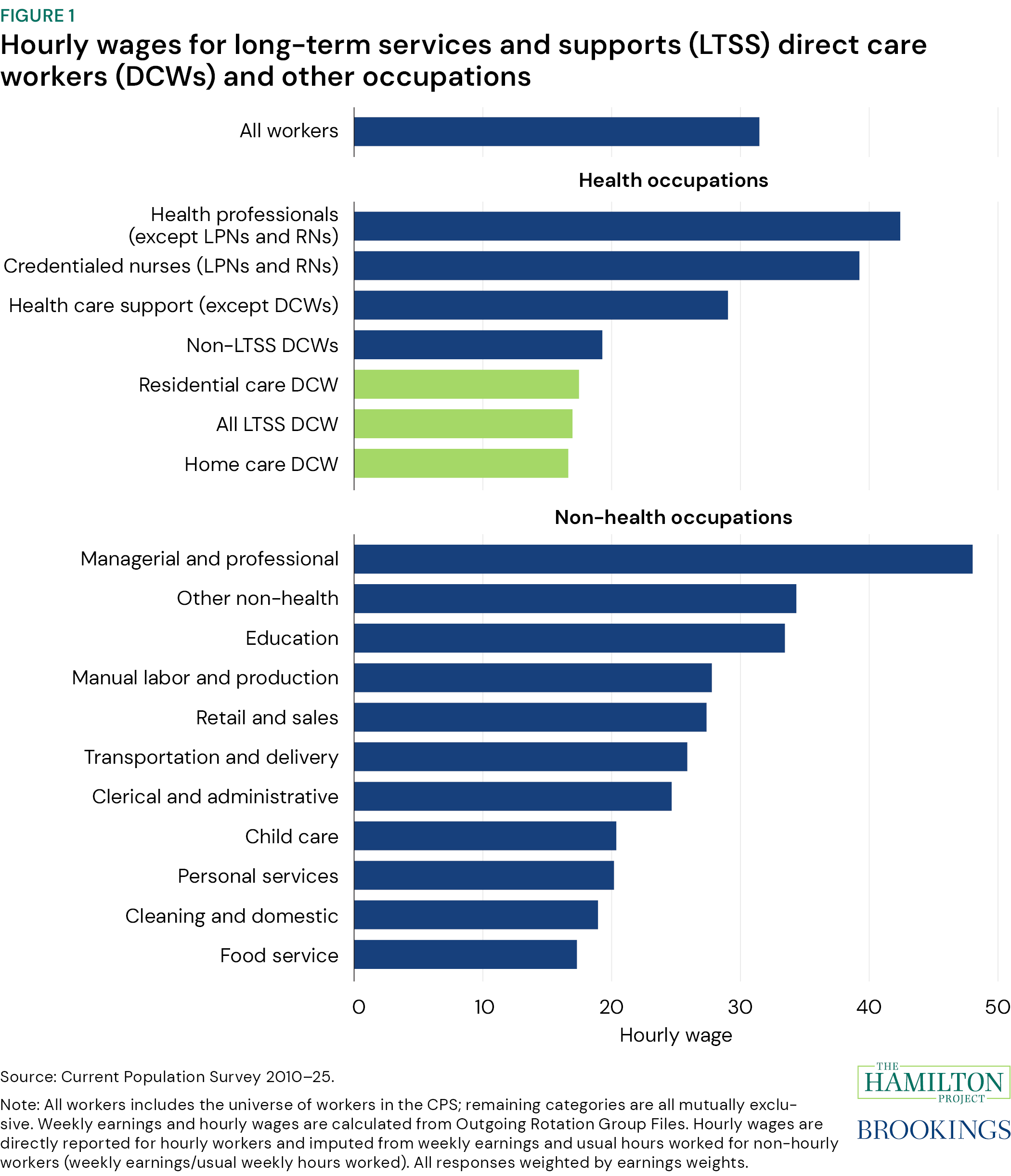
Figures 1 and 2 show characteristics of LTSS DCWs compared with other workers, including other nursing staff (LPNs and RNs) and workers in other health care fields, other care fields (education/child care), services (retail and food services), and other industry/occupation combinations.
Direct care workers, including both those in residential and home care receive lower average pay than other positions (figure 1). In the CPS data, wages for these workers average $16–17 an hour, less than half what credentialed nurses (LPNs and RNs) earn, and lower than DCWs in other industries ($19.27), child care ($20.36), and retail positions ($27.37), as well as the average among all workers ($31.47). LTSS DCWs earn slightly less than cleaning and domestic workers ($18.94), and somewhat more than food service workers ($17.30). Direct care workers are also less likely to have access to and receive non-wage benefits like pensions and health insurance than are workers in other caregiving and health care roles. In general, DCW wages and benefits are lower for workers in home care than in residential care (for instance, average wages are $16.63 among home care workers vs. $17.46 for those in residential care).
Demographic characteristics also differ between LTSS DCWs and the broader workforce (figure 2). Compared to other workers other than child care employees and LPNs/RNs, LTSS DCWs are more likely to be female. They are also more likely to be a race/ethnicity other than non-Hispanic white and to have no education past high school than most other groups of workers we examine, except cleaning and domestic workers. Finally, 25 percent of residential care DCWs and 33 percent of home care DCWs are foreign-born, compared to 19 percent of the broader workforce.
Figure 2. Characteristics of long-term services and supports (LTSS) direct care workers (DCWs) versus other occupations
Select direct care occupation:
Select comparison occupation:
Flows in and out of the DCW LTSS workforce
We disaggregate the industries and occupations that LTSS DCWs go to and come from in figure 3. About half of LTSS DCWs newly enter or leave this work each year. First examining those who leave these roles, we find that of people who were initially working as a LTSS DCW, about 8 percent are working in direct care fields in other health care industries (such as hospitals and physician offices) in the following year. Only about 3 to 4 percent of home care and 6 percent of residential direct care workers go on to work as LPNs and RNs in any industry. This low share of direct care workers transitioning to LPN or RN roles is perhaps unsurprising as RNs and LPNs typically require post-secondary training of at least one year. In addition, 4 to 7 percent are working in other, non-nursing health care support jobs in industries such as physician offices and hospitals (see technical appendix for a detailed list of occupations and industries in each category).
Figure 3: Occupations long-term services and supports (LTSS) direct care workers (DCWs) come from and go to
In total, 75 percent of residential care DCWs who leave for other employment go to work in other health care and LTSS jobs (including as a home care DCW); for home care DCWs, the corresponding share is 60 percent. No field outside health care and LTSS stood out as particularly connected to the LTSS DCW workforce, suggesting that the labor market for LTSS DCWs is primarily defined by health care workers, rather than other common low-wage work. Somewhat surprisingly given pay differentials across occupations, the flows in and out of LTSS DCW work are roughly symmetric—that is, the distribution of LTSS DCWs who come from different roles closely resembles the distribution of jobs they leave LTSS DCW work for. Similar patterns across industries and occupations persist when we examine monthly, rather than annual, flows.
Besides those who change jobs, a relatively large share—11 to 12 percent of residential care and 16 to 17 percent of home care DCWs—enter from non-employment or leave to non-employment. The most common activity while being in the labor force before entering and after leaving direct care work is caregiving (“Not employed detail”). This pattern highlights the close connection between paid and unpaid work for this workforce. Again, patterns are largely similar when looking at monthly flows.
Who becomes an LTSS DCW? Who leaves?
Figure 3 shows substantial worker flows in and out of LTSS DCW roles. We then ask: How do earnings and access to benefits in workers’ new and old jobs compare with LTSS DCW roles?
Figures 4, 5, and 6 compare demographic characteristics, wage trajectories, and measures of job quality among “stayers” (those who continued to work as residential or home care DCWs 12 months later) and “leavers” (those who leave their residential or home care DCW role 12 months later). For those who leave, wage and benefit changes are only reported for those who leave for other employment.
Workers who stay in LTSS DCW roles are more likely to be female, have no more than a high school education, and be foreign born than those who leave (figure 4, see also technical appendix). In addition, those who stay tend to be older. These patterns indicate that the workers who continue in these roles likely have the fewest outside options in the labor market.

There are also substantial differences in how job situations change for stayers and leavers.
Stayers typically receive a small wage increase of $0.50–0.59, whereas hourly wages for leavers increase by as much as $2.70 (figure 5). Workers who leave LTSS DCW roles experience an increased probability of working full-time and decreased probabilities of working multiple jobs. They also go to jobs that are about 10–20 percentage points more likely to receive employer-sponsored health insurance or a pension (figure 6). These patterns suggest that LTSS DCW roles are compensated relatively poorly and have fewer benefits when compared to the other jobs in their labor market.


Takeaways
This analysis finds that the LTSS DCW workforce differs from much of the broader labor market. Workers in these roles are more likely to be workers of color, foreign-born, female, and have lower levels of educational attainment than workers in other roles. Pay and access to non-wage benefits are also lower for residential and home care DCWs than for many other industries, particularly for home care. A substantial share of LTSS DCWs enter these roles from (and leave these roles for) other health care jobs, but relatively few come from or leave to other industries like retail and services. In addition, there are substantial flows between non-employment and LTSS DCW work, particularly among those who are not in the labor force for caregiving responsibilities. Workers who remain in DCW roles are more likely to be older, foreign-born, and have lower levels of educational attainment than those who leave. These patterns were documented during COVID-19; our analyses show these pandemic-era trends are a persistent and long-standing feature of the DCW labor market. In addition, we document that workers who leave LTSS direct care work receive a substantial wage increase the year after leaving and enter jobs with greater access to employer-sponsored insurance and pensions. As the population ages, demand for LTSS care is likely to grow, requiring a greater LTSS direct care workforce. The patterns on turnover and job characteristics we have documented illustrate challenges that likely require multi-pronged policy solutions in the coming years.
Acknowledgments
We thank Aviva Aron-Dine, Lauren Bauer, Gopi Shah Goda, Kate Miller, and Lina Stepick for helpful comments. Sarah Calame, Joyce Chen, and Eileen Powell provided excellent research support.
Footnotes
[1] Direct care workers (DCWs) are defined as nursing assistants, psychiatric aides, home health aides, and personal care aides. In this blog, we focus on DCWs providing LTSS, which we define as including both residential care (residential or nursing facilities) and home care (home health services, individual and family services, and private households); DCWs in remaining industries are classified as “Other DCWs.” Watson (2026) excludes psychiatric aides from her definition of DCWs and focuses on DCWs in all industries.