

The challenge
Many people report spending more time on social media than they would prefer, and social media and smartphone use rank among the top activities for which people perceive self-control problems. In this policy brief, Hunt Allcott (Stanford University), Matthew Gentzkow (Stanford University), and Lena Song (University of Illinois Urbana-Champaign) present evidence from an experiment that answers two related questions: whether people are addicted to social media and, if so, the extent to which digital addiction drives their use. Their research finds evidence that digital addiction drives about one-third of social media use.
The experiment
Allcott, Gentzkow, and Song studied digital addiction through an experiment with two interventions conducted in 2020. The study included roughly 2,000 American adults ages 18–64 and focused on six major platforms—Facebook, Instagram, Twitter/X, Snapchat, browsers, and YouTube.
Two hallmark features of addiction are habit formation and self-control problems. Habit formation means that current use increases future use or, conversely, reducing current use reduces future use. Self-control problems occur when individuals intend to reduce their use in the future but are unable to follow through when the future arrives.
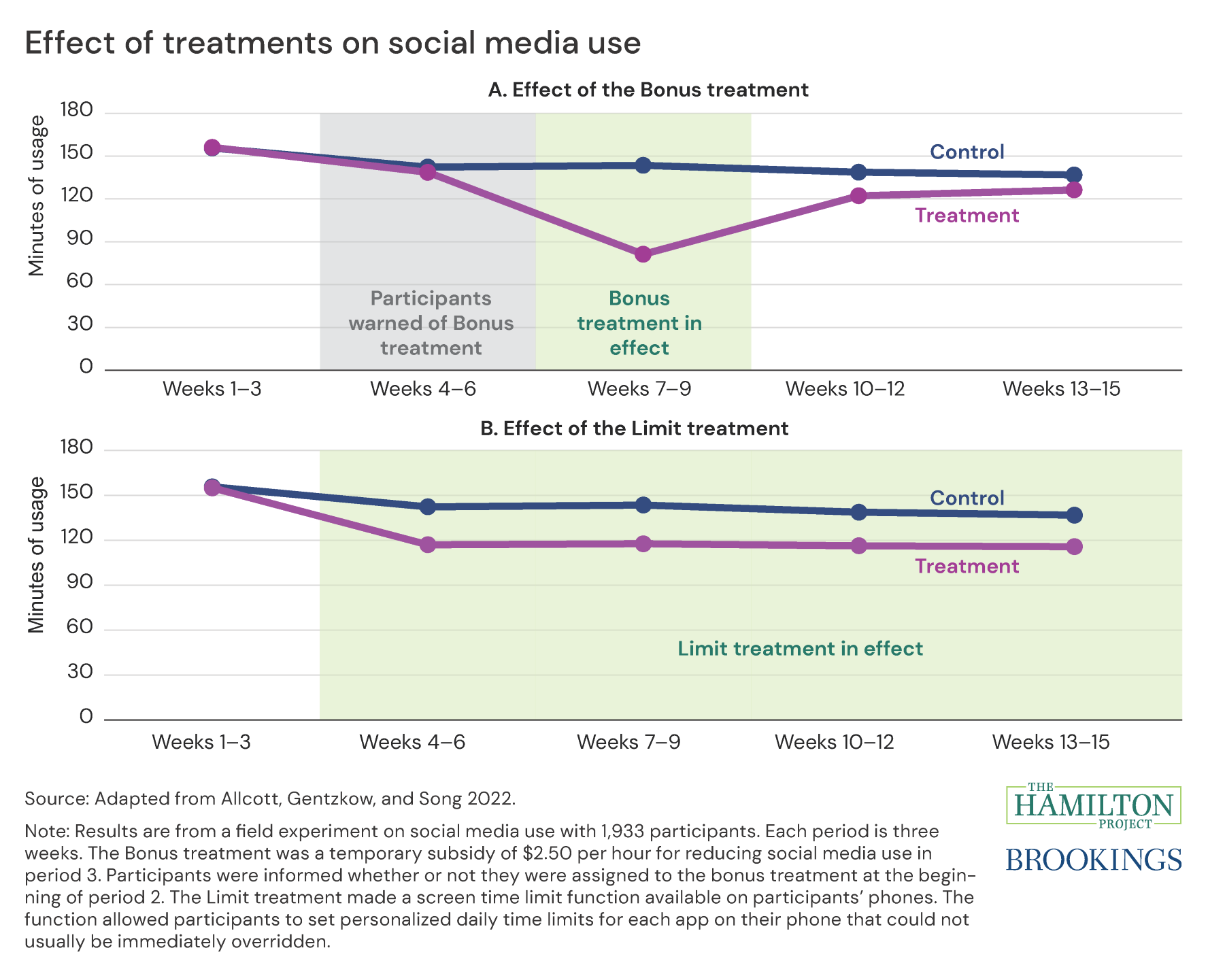
To measure habit formation, the authors paid people to reduce their social media use for three weeks (the Bonus treatment). Unsurprisingly, panel A shows that the Bonus treatment reduced use. More importantly, reduced use persisted even after the incentive payments ended. Reducing use today made it easier to use less tomorrow, a key signature of habit formation.
To measure self-control problems, the authors introduced a tool for participants to set their own daily screen time limits on social media apps (the Limit treatment). Participants were not required or even incentivized to use the feature, but 89 percent of those in the treatment group did so, and those randomly offered the tool significantly and persistently reduced use compared to the control group (panel B). Moreover, participants expressed willingness to pay for continued access to the feature after the experiment ended, showing that they valued the commitment mechanism.
The short-term reductions in social media use during the experiment also reduced the extent to which participants reported behaviors associated with addiction, including using smartphones to fall asleep, losing sleep from use, using longer than intended, using to distract from anxiety, having difficulty putting down their phone, and using mindlessly, and modestly improved self-reported overall well-being.
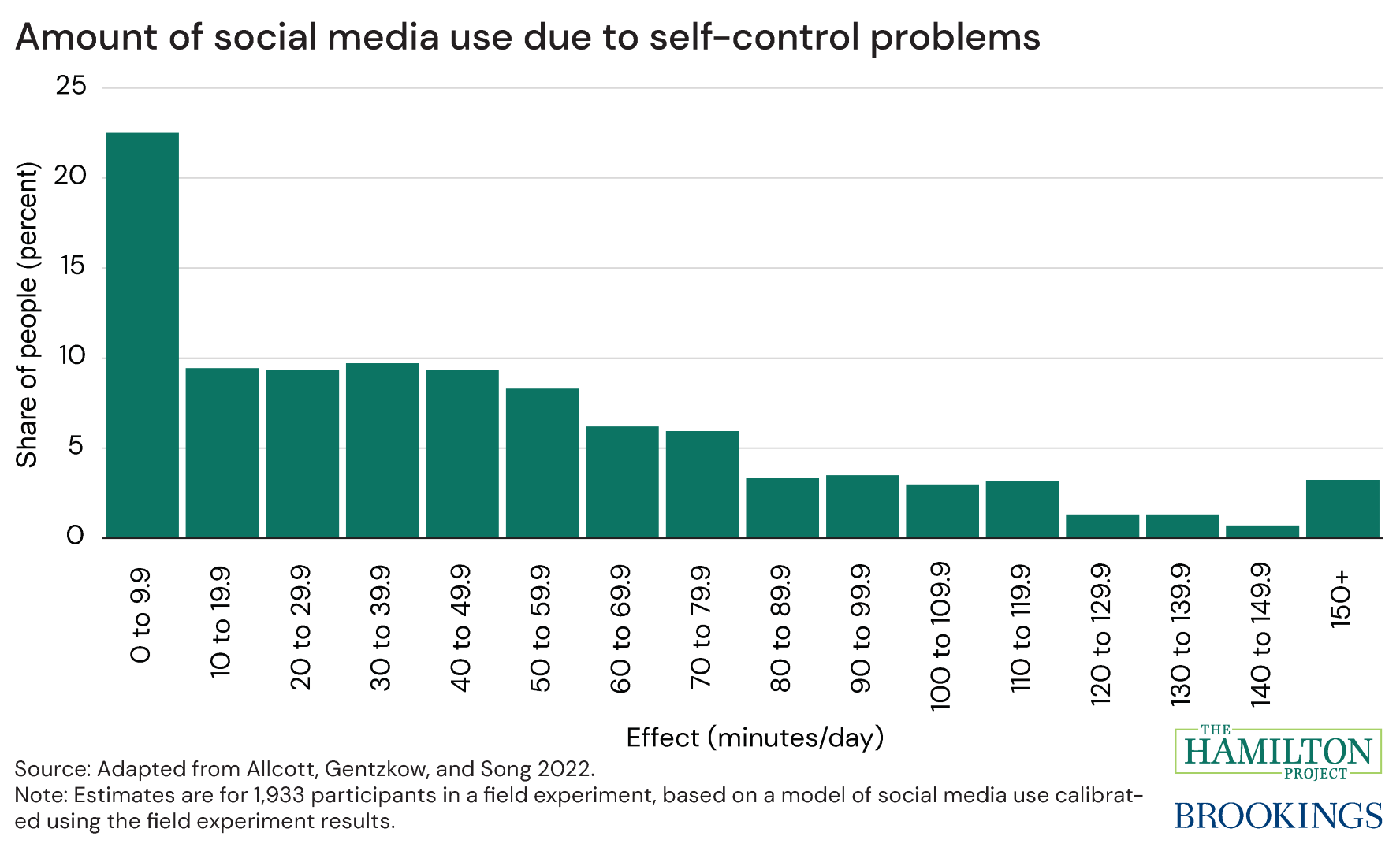
To quantify the overall contribution of digital addiction to social media use, the authors combine their experimental results with an economic model. They estimate that self-control problems, exacerbated by habit formation, account for an average of 31 percent (48 minutes per day) of social media use for participants in the experiment.
Policy implications
A key takeaway from these findings is that many people use more social media than they would like. This places digital media alongside other addictive goods—cigarettes, alcohol, consumer credit, and sugary beverages—where self-control problems have motivated policy intervention.
At the same time, the findings reveal substantial differences in the degree to which digital addiction affects individuals, a pattern that has important implications for policy design. While self-control problems contribute an average of 48 minutes per day to social media use, they contribute less than 10 minutes of excess use per day for 22 percent of participants and more than 60 minutes for another 32 percent.
The authors conclude that policymakers should consider interventions that would help users act in accordance with their own long-run preferences. Most directly related to the experimental results, policymakers could require platforms and device manufacturers to not only offer limit-setting tools as a built-in feature, but also regularly prompt users to consider setting limits, or even introduce default limits that users can adjust or turn off.
Policymakers could also consider prohibiting or regulating design features that amplify self-control problems, or holding platforms liable if they deliberately introduce features designed to maximize engagement at the expense of user well-being. In this context, a key challenge is distinguishing between design features that are addictive and features that are simply engaging. Additional research is needed—which means that another important policy priority is ensuring transparency and access to platform data.