

The challenge
Social media platforms and usage have grown rapidly over the past two decades. While one would typically assume that a popular product benefits its users, prominent critics have raised concerns that social media may instead be making many or most of its users worse off. Consistent with this hypothesis, Leonardo Bursztyn (University of Chicago), Benjamin R. Handel (University of California, Berkeley), Rafael Jiménez-Durán (Bocconi University), and Christopher Roth (University of Cologne) find evidence of a “product market trap:” At least among the college students in this experiment, large numbers of people are choosing to use social media platforms they also wish didn’t exist at all.
The experiment
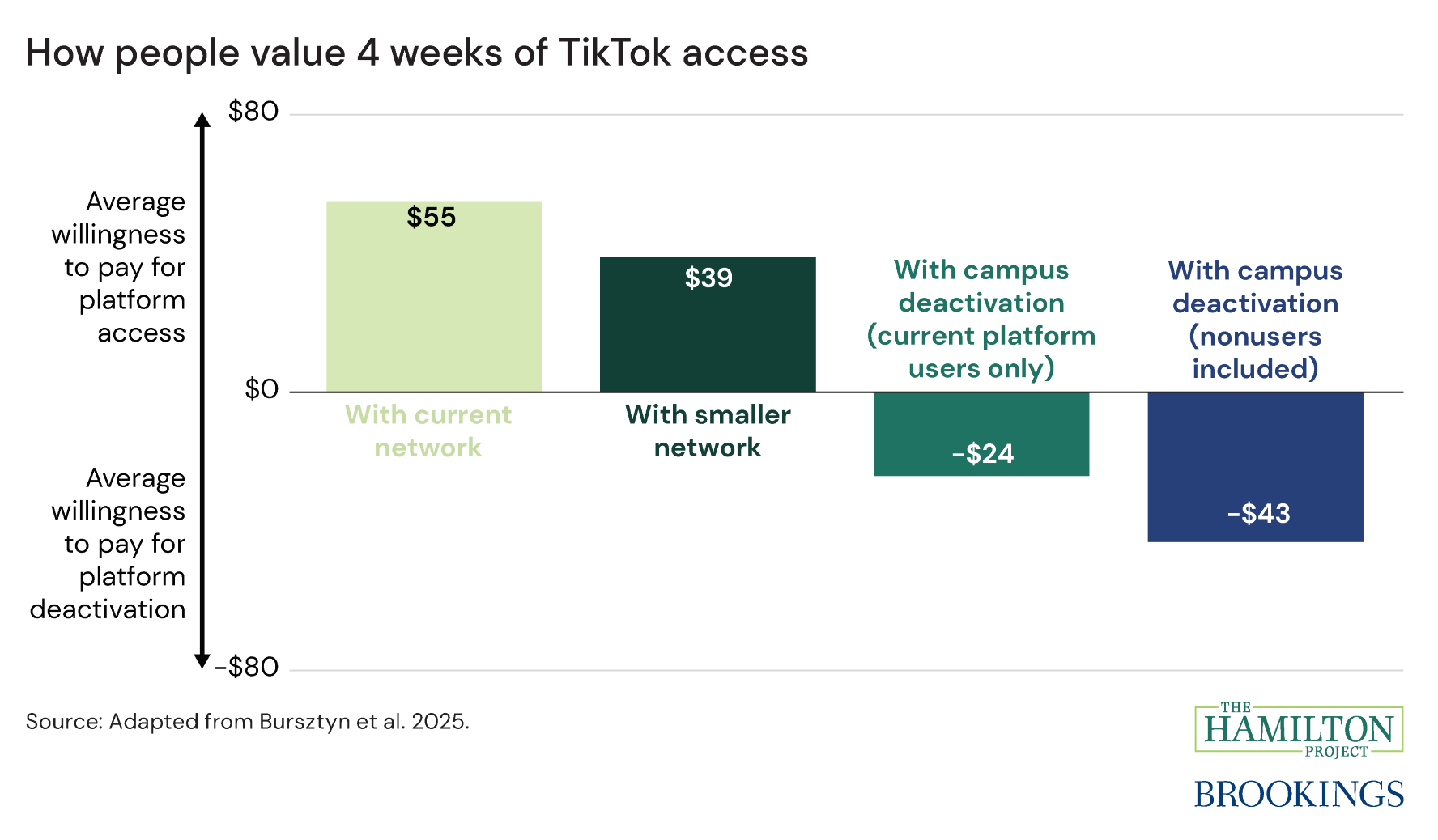
The authors measured U.S. college students’ willingness to pay for access to TikTok and Instagram under various conditions. Among the students in the sample, almost all social media users were willing to pay for access to social media platforms given these platforms’ current user bases; for example, students were willing to pay an average of $55 for four weeks of access to TikTok. Unsurprisingly, willingness to pay fell somewhat, to $39, when the number of other TikTok users on campus fell.
More surprisingly, when this same group of users was asked how much they would need to be paid to turn off social media platforms for themselves and everyone else on their campus, the authors found that they would instead be willing to pay an average of $24 to deactivate the platform on their campus for four weeks. This amount rose to $43 when they also included the minority of students who weren’t TikTok users. (Results for Instagram were similar and are included in the full policy brief.)
These results are stark, and they highlight how the product market trap framework is important for thinking about well-being and social media. Using standard measures, it seems as if consumers value social media. Yet, when digging deeper, it becomes clear that many feel compelled to use social media once it exists, even though they wish it did not exist to begin with.
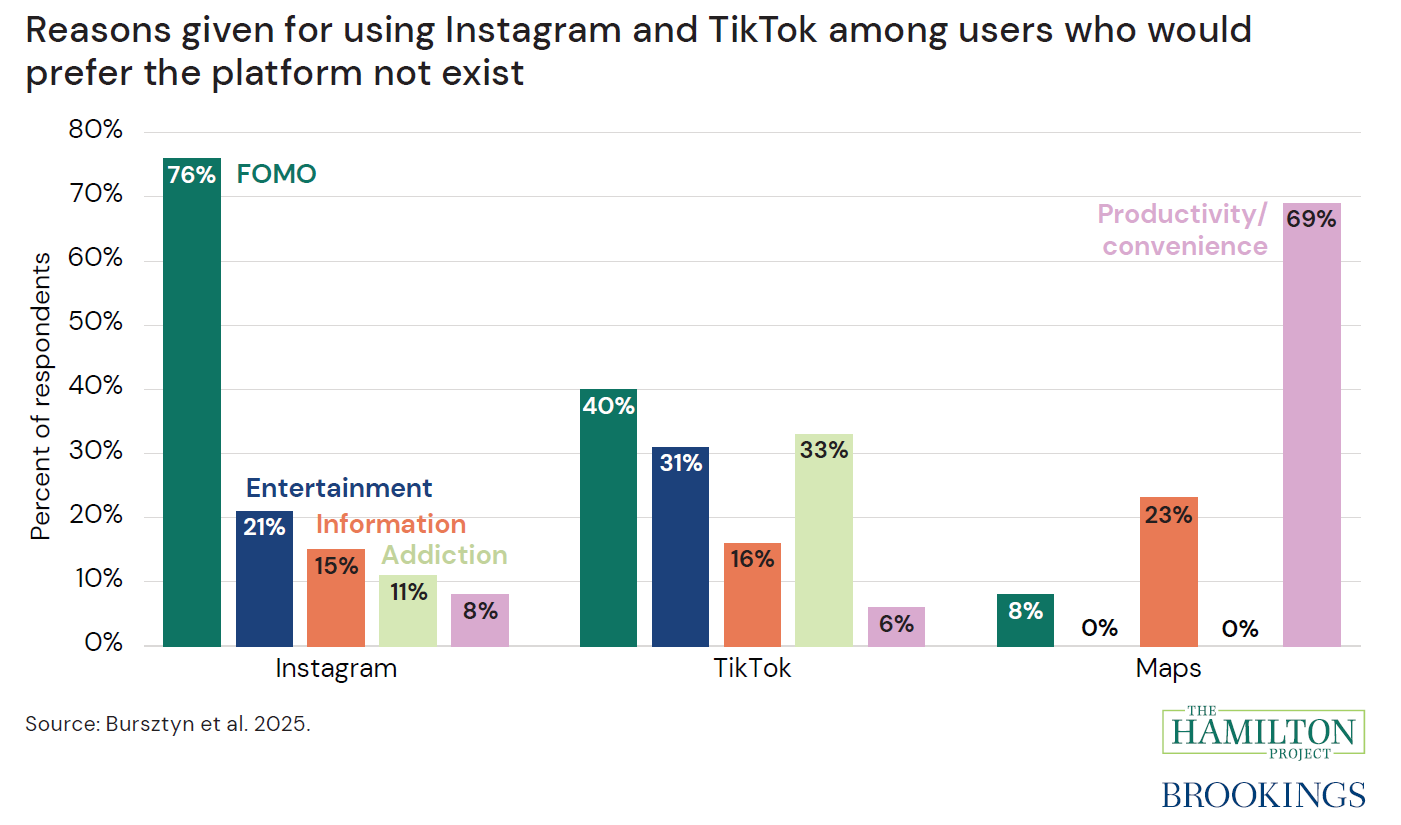
When students were asked why they were using a product they wish everyone—including themselves—would lose access to, the most common response was the “fear of missing out” (FOMO), meaning they are worried about what they will miss if everyone else uses social media and they do not. Students also referenced entertainment, information, and addiction.
Policy implications
Bursztyn et al.’s finding that many social media users are caught in a product market trap strengthens the case for proposals to restrict or regulate social media or to tax social media use. It shows that the growth of social media markets imposes costs (“negative externalities”) on nonusers, who feel pressured to use these products because others are using them. In the brief, Bursztyn et al. discuss policy options including voluntary coordination mechanisms, taxes or fees, and broad restrictions on children’s social media use, as well as implications for antitrust enforcement.
The authors conclude that, while their research provides evidence in support of a range of proposals to tax, regulate, or restrict social media use, it particularly strengthens the case for regulating or restricting platform and algorithm design features that exacerbate users’ FOMO if they do not use social media products. The existence of product market traps means a company can increase demand not by making its product intrinsically better, but by making the experience of not using it worse. For example, social media platforms use a range of features to increase divisions between account holders and non-account holders, which can make it more costly for people to stay away from a platform that some of their social network uses. The authors’ research supports efforts to regulate these features, which primarily serve to penalize nonusers.