
Editor’s note: At the time of publication, there are ongoing legal proceedings involving topics discussed in this publication. This recap reflects what was known at the time of the event, October 30 at 12:30 p.m.
On October 30, The Hamilton Project hosted a webcast to highlight the importance of the Supplemental Nutrition Assistance Program (SNAP) amid the ongoing government shutdown and in the wake of major cuts to the program in the One Big Beautiful Bill Act.
The event began with remarks from Aviva Aron-Dine, director of The Hamilton Project, who highlighted the importance of a strong social safety net.
Senator Amy Klobuchar (D-Minn.), ranking member of the Senate Agriculture Committee, delivered remarks criticizing USDA’s decision to not fund SNAP benefits for November and highlighting potential solutions, including legislation with bipartisan support to appropriate funds for SNAP and USDA complying with court orders to fund SNAP with currently available authorities and resources.
The senator also discussed cuts to SNAP in the One Big Beautiful Bill Act and the potential consequences of requiring states to pay a portion of SNAP benefit costs depending on their SNAP payment error rates.
Related content: “SNAP cuts in the One Big Beautiful Bill Act will significantly impair recession response”
A panel with Stacy Dean (formerly USDA), Danielle Perry (Greater Chicago Food Bank), Diane Schanzenbach (Georgetown University and Brookings), and David Super (Georgetown Law), moderated by Lauren Bauer (Brookings) examined the economic, legal, philanthropic, and policy considerations surrounding SNAP.
Super opened the panel with a presentation on the questionable legality of the Trump administration’s position. In his presentation, he explained that Congress provided a $6 billion SNAP contingency fund for use “at such times as may become necessary to carry out program operations” (P.L. No. 118-42, Div. B, tit. IV). In addition to the contingency fund, Super continued, “Under Section 2257, [USDA has] the ability to transfer money within programs under one agency. … And there turns out to be plenty of money in the child nutrition accounts, roughly $30 billion dollars.”
Super questioned the administration’s assertion that SNAP contingency funds are not available to support regular benefits: “There’s nothing in the law that says that. That’s something they made up. And that, again, is something they didn’t say as recently as September 30 in their contingency plan.”
Dean offered insights from her experience as the former USDA deputy under secretary for food, nutrition, and consumer services, stating it was her understanding that the SNAP contingency fund is to be used to pay benefits during a shutdown, “If you had asked me in early October what would happen to SNAP in November, I would have said that based on my experience, I expect the administration will release contingency funds to pay—and since they would be insufficient to cover a full month—a pro rata share of November benefits to provide states with some administrative funds. This would have been the minimum action.” Like Super, Dean emphasized that using contingency funds to pay benefits during a shutdown has been “the longstanding understanding” based on contingency plans from multiple administrations.
Perry discussed the increased burdens food banks are preparing to face, not only from the USDA’s decision to not issue SNAP benefits on November 1, but also from changes to SNAP work requirements in the One Big Beautiful Bill Act. Speaking of the Greater Chicago Food Depository, Perry explained that “We are, right now, at an average of 175,000 households a month. That’s near the number we had during the height of COVID. So, we are now walking into a new crisis at the height of need.”
Schanzenbach expanded on changes to SNAP in the One Big Beautiful Bill Act, including changes to time limit work requirements, state work requirement waivers, and the share of benefits that states pay. She emphasized that these changes come at a time of uncertainty in regard to the state of the economy, arguing, “I would say we’re in a risky time period, and cutting back on this important social safety net benefit that stimulates and supports the local economy is not, in my professional opinion, a wise move right now.”
Q&A
The event concluded with audience Q&A. Answers have been edited for length and clarity.
What is going to happen in November if this is not resolved?
Dean: “One thing that’s important for folks to understand, particularly participants, is not all benefits are paid on November 1. … So, this will be quite acute for those individuals who are paid on the first, second, and third. They won’t see those November benefits loaded on. If you’re normally paid on the 10th, 17th, or the 23rd, which is certainly a smaller share of the case load, this doesn’t signal that there is an impact for you. There is still time for Congress to resolve the shutdown for benefits to be loaded.
… The other thing I’ll say is I’m worried that participants are going to find out when they go to the grocery store on the first or the second, and that that is going to make for a very difficult interaction between the shopper and the cashier, who has to tell them there aren’t benefits on your account. Not everyone is getting all of the information, and there could lead to a lot of confusion.”
How is the charitable food sector able to respond, and what are the limits?
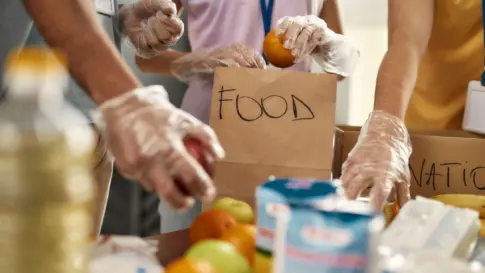
Perry: “For every meal the emergency food system can provide, SNAP provides nine. There is absolutely no way that charity can fill the gap of SNAP. As much as we need your help, and we want the donations and the volunteerism, it’s important for us to lift that up, so people know the power of SNAP, that it helps families in a way that we just, as charity, can’t do. But that doesn’t mean we’re not going to try. That’s who we are. We have shown up in crisis time and time again, from COVID to the new arrivals to past shutdowns. We will do that again.
We appreciate the donations that are pouring in, the people who are showing up to help us pack those additional boxes, people who are volunteering even at their local pantry—because can you imagine what this is going to require the pantries to have to be able to do, most of which are small faith institutions who use the volunteerism of many of our seniors. To see our community stand up in this moment, volunteer and donate, we need to do that. But we also need to appreciate that it’s just not going to be enough. People will go hungry.”
What can (and can’t) states do?
Super: “States are being put in a terrible bind here. Danielle is quite right that private charity doesn’t have anything like the resources to make this up, but really, states don’t either. States’ budgets are tight. The economy is, at least in a number of places, getting a little more difficult. That shows up in state tax revenues fairly rapidly. The notion that states just have, cumulatively among them, lying around, another $8 billion that’s gathering dust is completely fancy. We’ve heard some states talking about intervening, and I think then they look at the price tag, and they don’t do it. And USDA has been not encouraging that states would get repaid even if they fronted the money for SNAP. There’s not a permanent mechanism that’s ever been used in the Food and Nutrition Act to do that. We’ve heard rumors about this and that but thinking that states can fill the gap is just completely unrealistic here, both legally and fiscally.”
This is an event summary of “Addressing threats to the SNAP program.”