

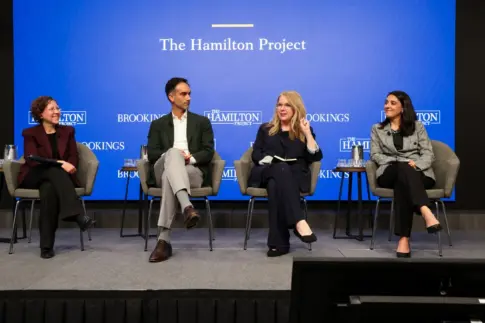
On September 29, The Hamilton Project at the Brookings Institution hosted an event to discuss policies for expanding access to long-term care. Alongside the event, The Hamilton Project released a proposal for a new visa for direct care workers, an assessment of Medicare’s home health benefit, and an analysis exploring the nursing home and home care workforce.
Hamilton Project Director Aviva Aron-Dine opened the event by framing the challenge: “As the number of older Americans grows, so too will the need for long-term care. Meeting those needs will require growing the long-term care workforce, improving access to long-term care, and addressing the uneven quality of long-term care services and supports.”
Panel 1: Immigration and the care workforce
The first panel discussed how immigration can help close the care workforce gap. Jonathan Cohn (The Bulwark) moderated a conversation with Maggie Elehwany (Argentum), Nicole Howell (National Council on Aging), Tara Watson (Brookings Institution), and Haeyoung Yoon (National Domestic Workers Alliance).
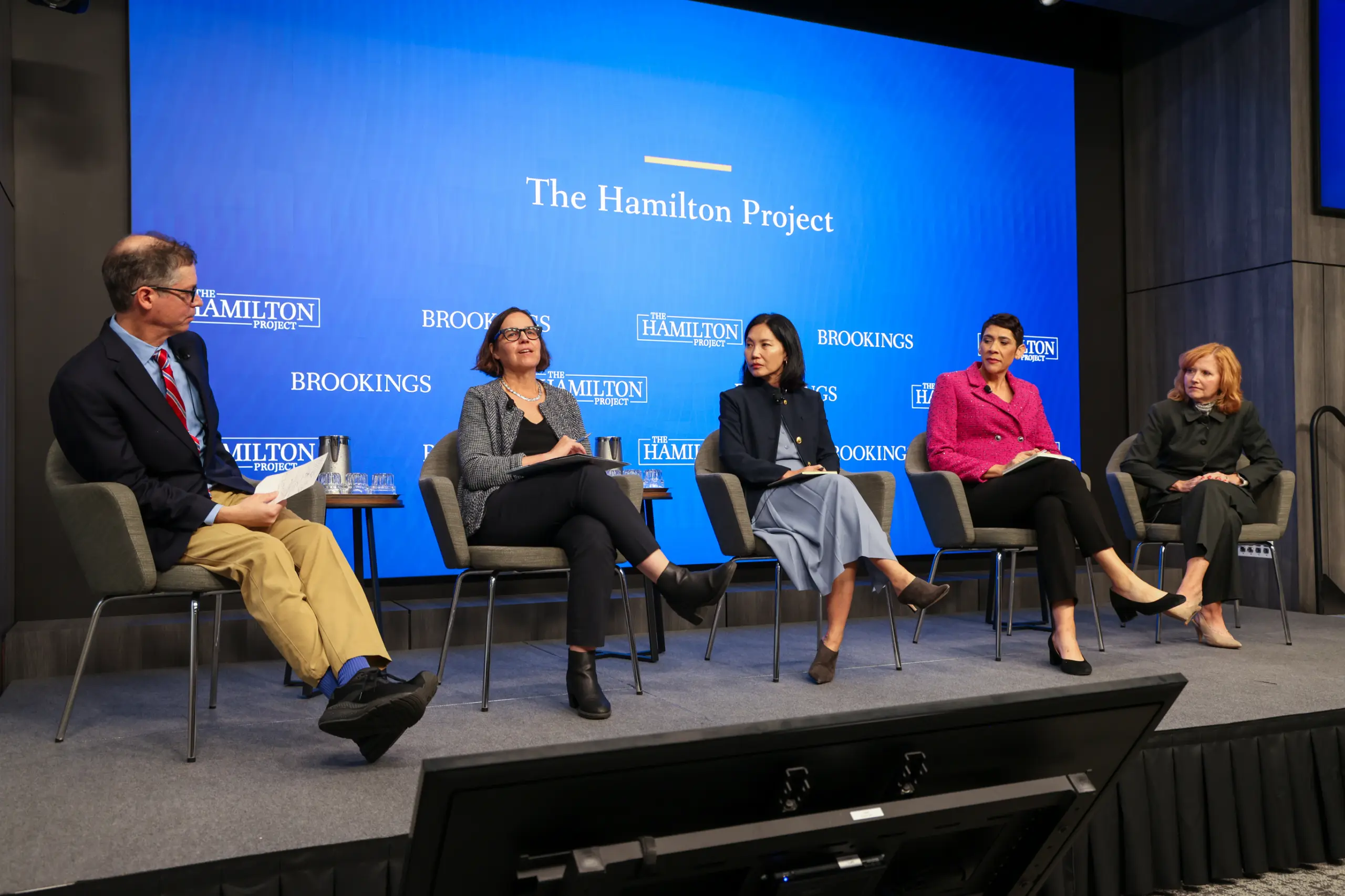
Jonathan Cohn, Tara Watson, Haeyoung Yoon, Nicole Howell, and Maggie Elehwany speak at The Hamilton Project’s event, “Meeting long-term care needs for an aging United States.” Photographer: Ralph Alswang
Watson presented a new proposal for a direct care worker visa, called the H-1D. “Our projections suggest that we will need about 1.3 million more direct care workers than we have today in 10 years,” she said. She added that the existing domestic workforce and regular immigration flows alone are unlikely to fill this gap.
The H-1D would be for those already in the direct care field and available to both new immigrants and immigrants already living in the United States. Like an H-1B visa, it would be tied to employment, structured as a three-year initial visa with an option for renewal, and dual intent with the possibility of leading to permanent residency. Additionally, the H-1D would include provisions to protect both the visa-holders and the existing workforce, such as a requirement for employers to pay the 75th percentile of the existing direct care wages in the local area, to prevent downward pressure on wages and alleviate concerns about undercutting.
Speaking from the experience of senior living providers, Elehwany called Watson’s proposal “a commonsense solution,” arguing that “the workforce shortages are absolutely a crisis.”
Elehwany also stressed that no single fix will be enough:
“The problem is so egregious that there’s not just a silver bullet. There has to be some type of immigration reform. There has to be some type of commonsense internal workforce development, changing of federal and state programs.”
“By 2030… we’re going to have more seniors than we will [have] children for the first time in our country’s history. By far the fastest growing segment of that population are those who are 85 and older, the ones who are going to need the most care. We are not being forward-thinking and preparing for that need. … Two-thirds of Americans who reach the age of 65 are going to need some type of long-term care. Nobody’s thinking about it, nobody’s planning for it, and we’re certainly not preparing the workforce we need to do that.”
–Maggie Elehwany, Argentum
Howell offered her perspective from working with states to address their direct care workforce needs. She said states are “recognizing this is really about a systems issue” and are “seeking to really understand what are the challenges in their state that they are facing.”
Yoon applauded Watson’s proposal and shared that the National Domestic Workers Alliance, which represents domestic workers including home care and direct care workers, has also called for creating a legal pathway for eligible immigrants in care jobs. She said, “Immigrant workers play a foundational role in caregiving already. … About 30 percent of direct care workers are immigrants, and our members—both those who are U.S. born, who [have] status and those who may not, and immigrant workers—really think it is important to connect immigration policy change to changes that we need to build a robust care system.” She concluded, “The future of immigrants is really fundamentally connected with the future of care in this country.”
“The future of immigrants is really fundamentally connected with the future of care in this country.”
–Haeyoung Yoon, National Domestic Workers Alliance
Panel 2: Expanding access to care
Aviva Aron-Dine moderated the second panel with Carole Johnson (University Hospital), Neale Mahoney (Stanford University), and Tisamarie Sherry (Urban Institute).
Mahoney gave an overview of a new paper on the Medicare home health benefit, in which he and his coauthors find that Medicare home health lacks a clear, agreed-upon objective. They outline three potential objectives for the program and offer reforms to better meet these goals. The paper also explores how other countries have addressed some of these challenges, in particular the use of cash or near-cash programs.
Johnson shared her perspective from experiences in federal and state policy roles and her current role at University Hospital. She highlighted the interactions between Medicare home health and Medicaid, saying, “Thinking about how you do anything to the Medicare home health benefit without considering the implications for Medicaid just doesn’t feel like a complete policy consideration of the issue. … Learning from what’s happening in Medicaid—how you integrate in and how good dual programs work—is really the charge going forward.” She also discussed gaps in long-term services and supports, such as the particular challenges faced by people who are housing vulnerable or who are undocumented.
Sherry said gaps in home care are “pervasive” across demographic groups and income levels. But while much of the conversation around long-term care reform focuses on middle-income families, she added, “There’s still a lot of work to do at the bottom of the income scale as well … and the safety net programs that we rely on to provide care for lower income adults and address long-term services and supports needs are leaving people facing a lot of gaps.” She concluded, “Unfortunately, due to recent policy changes, these trends are likely to worsen in the coming years.”
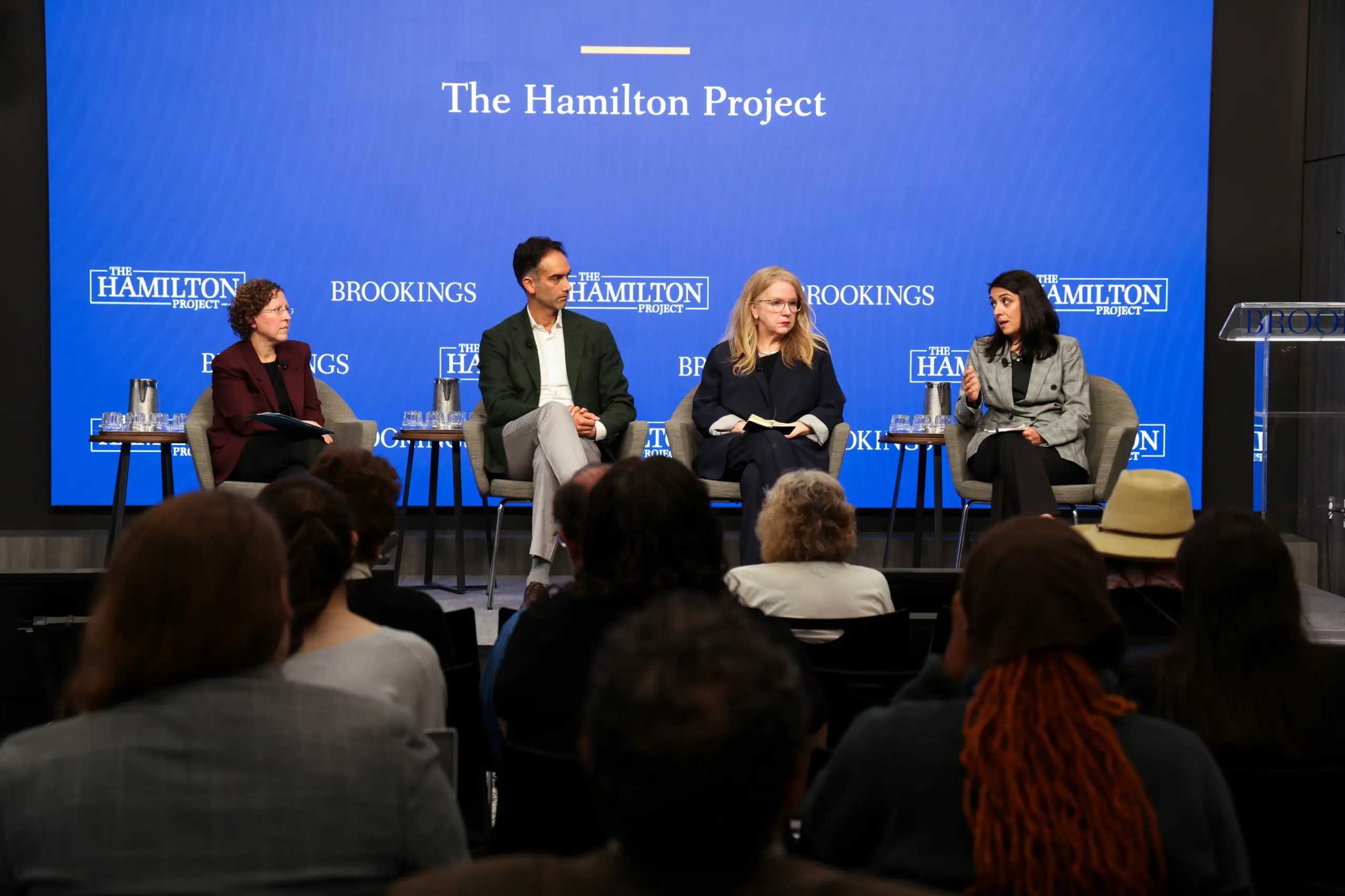
Aviva Aron-Dine, Neale Mahoney, Carole Johnson, and Tisamarie Sherry speak at The Hamilton Project’s event, “Meeting long-term care needs for an aging United States.” Photographer: Ralph Alswang
In the Q&A, the panelists called for more robust data on long-term care, highlighting the challenges of observing and measuring quality of care. The panel also stressed that workforce shortages make it difficult to maintain the robust staffing that is crucial for quality of care. Returning full circle back to the topic of the first panel, the speakers advocated for policy reforms to strengthen the direct care workforce.
Johnson called for greater investment into the direct care workforce:
“Most immediately before this role, I was the administrator of the Health Resources and Services Administration, which is the part of HHS [the Department of Health and Human Services] that invests in the workforce. All of our discretionary dollars focused on the advanced professional in the health care workforce. So, we’re investing money in training more nurses, in loan repayment to train more physicians, in training more social workers. We didn’t have a program for CNAs [Certified Nurse Assistants]. We didn’t have a program for direct care workforce. And that’s where you start to see the gaps that happen here, where no one would say the discretionary dollars that we spent on the advanced workforce were solving the whole problem, but we were making a dent in getting people to the highest need communities with those resources—and we don’t have that same type of investment in the direct care workforce.”
–Carole Johnson, University Hospital
This is a recap of “Meeting long-term care needs for an aging United States.“