

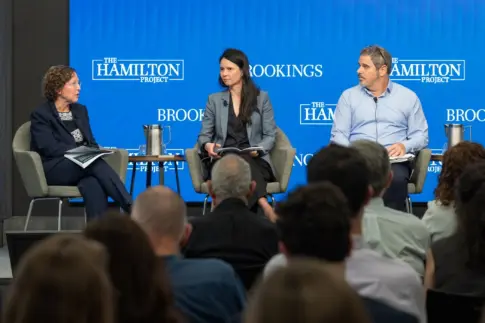
On June 16, The Hamilton Project at the Brookings Institution, the Tax Law Center at NYU Law, and the Urban-Brookings Tax Policy Center hosted an event on business tax reform. In conjunction with the event, The Hamilton Project released three policy proposals addressing corporate tax reform in the wake of the One Big Beautiful Bill Act of 2025; taxing large pass-through businesses as corporations; and the path forward on international tax reform. The Hamilton Project also released an essay on the need for revenue-raising business tax reform.
In welcome remarks, former U.S. Treasury Secretary Robert E. Rubin warned of the country’s unsound fiscal trajectory and underscored the need to raise additional revenue, including from businesses.
The first panel discussion featured Lily Batchelder (NYU Law), Kimberly Clausing (UCLA Law), Elena Patel (Tax Policy Center), and Arvind Ravichandran (Cravath, Swaine & Moore LLP), moderated by Richard Rubin (The Wall Street Journal).
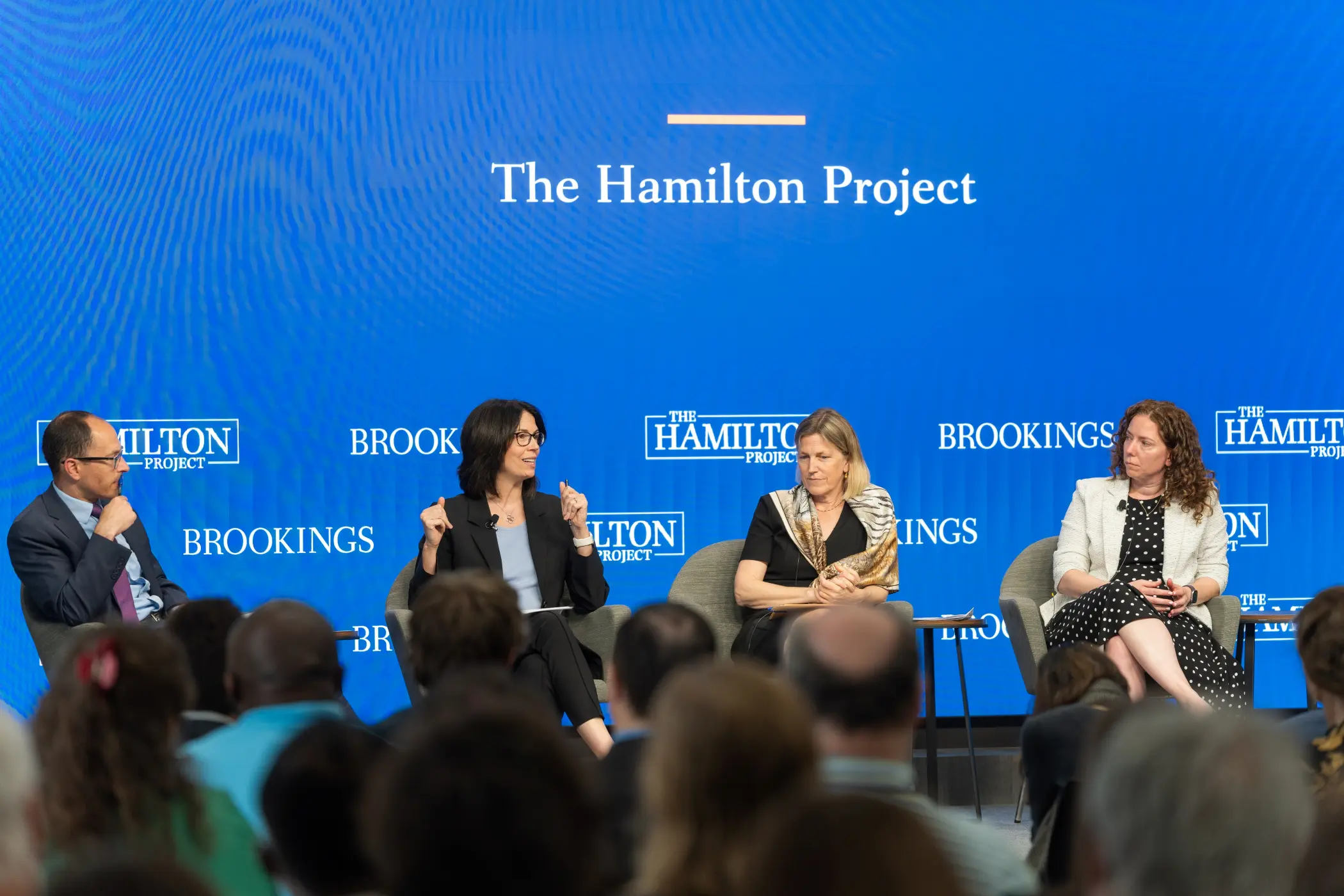
Richard Rubin, Lily Batchelder, Kimberly Clausing, and Elena Patel speak at “Taking on tax: The future of corporate taxation,” hosted by The Hamilton Project, the Tax Law Center at NYU Law, and the Urban-Brookings Tax Policy Center.
Patel outlined a new proposal to complete the transition of the U.S. corporate tax to a border-adjusted cash-flow tax with a broad base. “The starting point for the paper is really just admitting that the U.S. corporate tax reform project is unfinished,” she said, adding that Congress has incrementally moved the U.S. corporate tax from an income tax partway to a tax on business cash flows. “As a result, we have a hybrid system that…has the problems of both systems, without the virtues of either.”
Patel argued that completing the transition to a border-adjusted cash-flow tax would raise “more revenue, from a more progressive base, with less distortion to the economy.” The proposal, co-authored by William Gale and Adam Looney, has four components: completing the transition to a domestic cash-flow base; cleaning up special provisions in the tax code; taxing goods based on where they’re sold, not where they’re produced; and raising the rate to 25 percent.
Next, Clausing offered an overview of her proposal to strengthen the U.S. corporate tax while better aligning U.S. corporate tax policy efforts with international collective action. Clausing argued that corporate tax reform could raise needed revenue, and address important policy goals, including collecting revenue from profits on artificial intelligence. Clausing’s proposal includes higher corporate rates for the large corporations that account for the overwhelming share of corporate income and strengthening the minimum tax on foreign profits of U.S. multinationals; she also discussed the importance of getting rid of the tariff regimes of the first and second Trump administration.
Batchelder shared three concerns with moving to a border-adjusted cash-flow tax, as proposed by Gale, Looney, and Patel. She suggested that such a tax faces political constraints, might not provide the hoped-for efficiency and distributional benefits, and would harm multilateral tax cooperation. “My preferred solution, given these, would be to shift … back towards a corporate income tax and raise the rate as well,” she concluded.
Ravichandran offered additional critiques of the proposals. He emphasized that ideas that are great in concept could be fundamentally undermined by the details of implementation, as was the case (he argued) with the Corporate Alternative Minimum Tax.
In the second panel discussion, Chye-Ching Huang (Tax Law Center), Gregg Polsky (NYU Law), Monisha Santamaria (KPMG US), and Eric Zwick (University of Chicago Booth) focused on the taxation of pass-through businesses. Aviva Aron-Dine (The Hamilton Project) moderated the discussion.
To begin, the panelists discussed the history and challenges of partnership taxation. Panelists generally agreed that partnership tax rules were designed for a business model and environment that no longer exist today, leading to lost revenue and other challenges.
Huang shared a new proposal examining an approach that many have suggested to address these problems: taxing large pass-through entities as C corporations. Although many have raised this idea, the authors struggled to find a recent, detailed proposal: “So, really, what this paper was about was taking that idea that was either conceptual or old, and trying to turn it into something tangible that we could then poke at and see whether or not we liked it,” Huang explained.
In their paper, the authors find that the proposal would require careful and detailed policy design. Despite the challenges, Huang concluded, “We do think, ultimately, the policy can be made workable, and it really does belong on the menu of what we think of as options to raise revenue and do so in a progressive manner.”
Polsky, Santamaria, and Zwick offered their reactions to the proposal.
“Partnership tax, as it currently exists, is completely, irretrievably broken,” Polsky said. Acknowledging that “the devil is obviously in the details,” he concluded that the proposal is worth considering as a realistic alternative to more radical fixes.
Santamaria agreed that partnership taxation deserves attention and commended the authors for addressing many of the difficult design choices in their appendix. She shared several critiques of the proposal, including that it could reduce flexibility, divorcing tax and economics, and it could create new tax avoidance opportunities and raise less revenue than hoped.
Zwick focused on the heterogeneity of the pass-through sector. He agreed with the proposal’s intention to harmonize and reduce complexity, but raised the question of whether policy responses should be more targeted, for example, focusing on the particular tax challenges posed by complex, multi-tiered partnerships.
This is a recap of “Taking on tax: The future of corporate taxation.”